Holocaust Education & Archive Research Team |
Sobibor ---------------------
A-R Leadership
A-R Articles
Action Erntefest Modern Research | |||||||||||||||
The Sobibor Death Camp
The Sobibor death camp was located near the Sobibor village, which was located in the eastern part of the Lublin district of Poland, close to the Chelm – Wlodawa railway line. The camp was 5km away from the Bug River which today forms the border between Poland and the Ukraine.
In 1942 the area around Sobibor was part of the border between the General Government and the Reichskommissariat Ukraine, the terrain was swampy, densely wooded and sparsely populated.
Sobibor was the second death camp to be constructed as part of the Aktion Reinhard programme, and was built on similar lines to Belzec, incorporating the lessons learnt from the first death camp to be constructed.
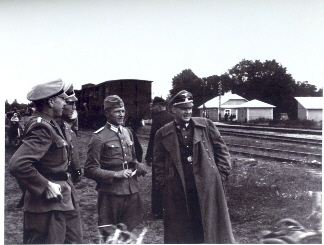
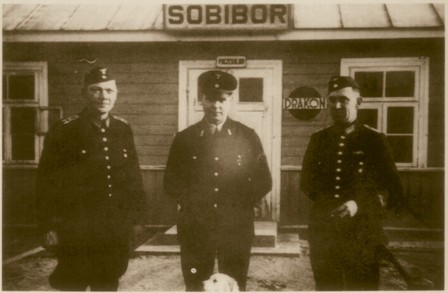
In the early months of 1942 after a reconnaissance visit by a small aircraft that circled over the village, a train arrived at Sobibor, two SS officers disembarked, they were Richard Thomalla, who worked in the SS-Zentralbauleitung Zamosc, and Baurath Moser from Chelm. They walked around the station, took measurements and eventually made their way into the forest opposite the railway station.
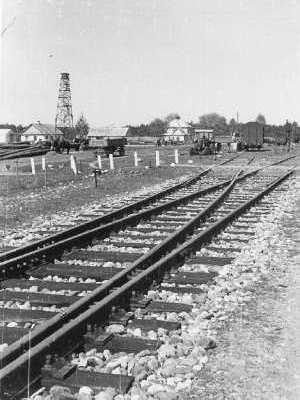
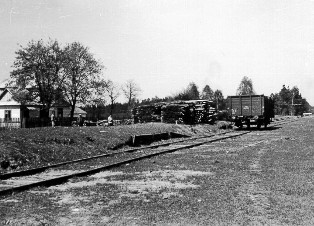
In March 1942 a new railroad spur was built, which ended at an earthen ramp, the ramp was opposite the station building. The camp fence with interwoven branches was built in a manner which ensured that the railway spur and the ramp were located inside the camp, thus preventing passengers at the station from observing what happened in the camp.
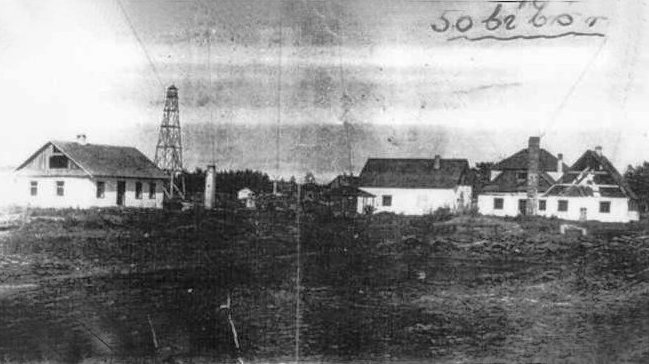
The deportation trains entered the ramp through a gate and disappeared behind the “green wall.” In the station area three larger buildings existed – the station, the forester’s house, and a two-storey post office. There was also a sawmill and several houses for workers.
As construction work progressed, undertaken by 80 Jews from nearby ghettos, such as Wlodawa and Wola Uhruska, the site was inspected by a commission led by SS-Hauptsturmfuhrer Neumann, head of the Central Construction Office of the Waffen –SS in Lublin.
Once the Jews had completed the initial construction phase, they were gassed during an experimental gassing. Two or three of them escaped at that time to Wlodawa and informed the Hassidic rabbi there, what was happening in Sobibor.
The rabbi even proclaimed a fasting in memory of the first victims and also as a sign of resistance. Both the escapees and the rabbi were denounced by a Jewish policeman and all of them were executed.
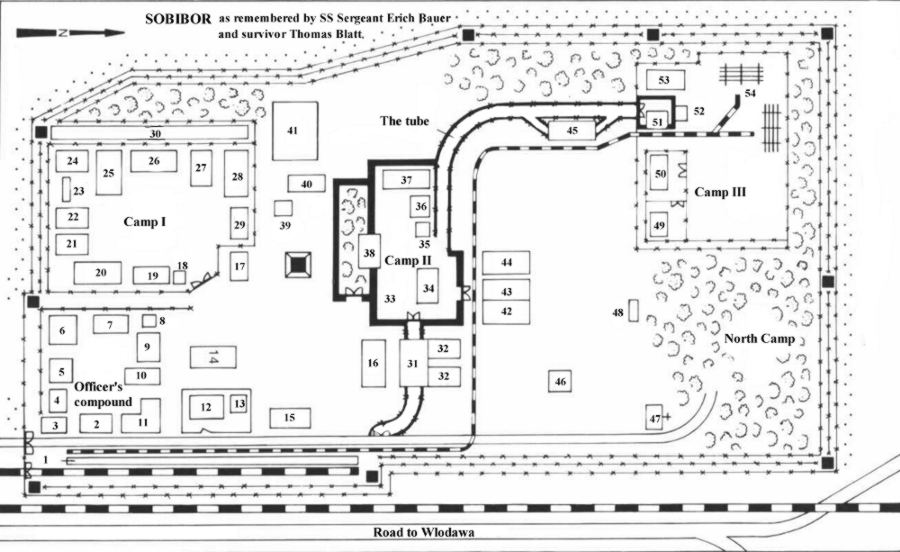
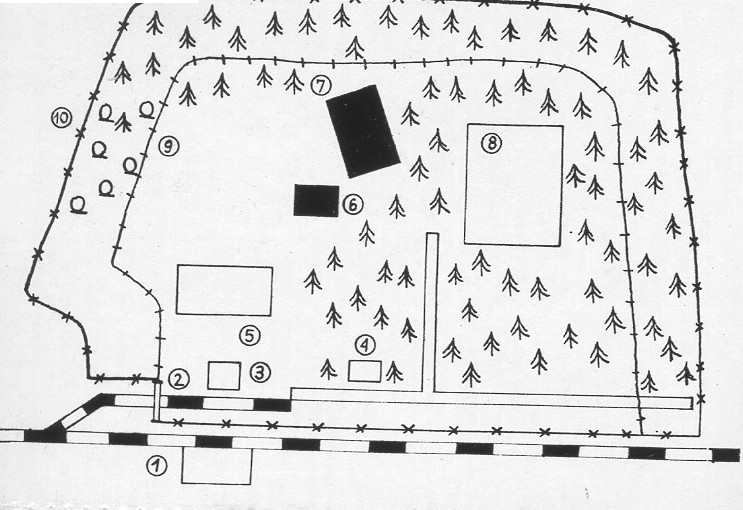
The camp was in the form of a 400 x 600m rectangle, surrounded by a 3m high double barbed-wire fence, partially interwoven with pine branches to prevent observation from the outside. Along the fence and in the corners of the camp were wooden watchtowers.
Each of the four camp areas was individually fenced in: the SS administration area (Vorlager), housing and workshops of the Jewish commando (Camp 1), the reception area (Camp II) and the extermination area (Camp III), in 1943 a munitions supply area (Camp IV) was added.
The ‘Vorlager’ included the ramp, with space for 20 railway cars, as well as the living quarters for the SS staff and Trawnikimanner. Also included was the main gate, on top of the main gate was a wooden sign about 0.60 x 2.40m with the words ‘SS- Sonderkommando Sobibor, painted in Gothic letters. Unlike the death camp at Belzec, the SS men lived inside the camp area.
The Jews from the incoming transports were brought to the ‘reception area’ (Camp II), here they had to go through various procedures prior to their death in the gas chambers: division according to sex, the surrender of the suitcases, the confiscation of possessions and valuables, removal of clothing and the cutting of the women’s hair.
On their way to the gas the naked victims passed various buildings, some warehouse barracks, a second former forester’s house, which was used as the camp’s offices and living quarters for some of the SS men, separated by a high wooden fence, a small agricultural area with stables for horses, cattle, swine and geese and about 250m south of the gas chambers a small wooden Catholic chapel, in the shadow of tall pine trees, which was now the ‘Lazarett’ and high observation tower used by the forester, overlooked the entire area.
The most isolated area in the camp was the extermination area (Camp III) was located in the north-western part of the camp. It contained the gas chambers, mass graves and housing for the Jewish prisoners employed there.
A path 3 to 4m wide and 150m long, ‘Die Schlauch (The Tube) cynically known by the SS in the camp as the ‘Himmelfahrtstrasse (Street to Heaven) led from the reception area to the extermination area. On either side the path was fenced in with barbed –wire, intertwined with pine branches. Through it the naked victims were herded towards the gas chambers. The barber’s barracks, where the hair of the Jewish women was cut off, was built near the end of the tube. The hair was used by the Germans for a number of uses such as mattresses for u-boats, slippers etc.
The three gas chambers were inside a brick building - individual chambers were square shaped, 4 x 4m and had a capacity of 160 – 180 persons. Each gas chamber was entered through a small door, leading from a veranda which ran along the length of the building. After gassing the bodies were removed through a 2 x 2m folding door, opposite to the entrance, and placed on a second veranda.
Outside the building was an annex in which a motor produced the deadly carbon monoxide gas, water pipes conducted the gas to the gas chambers. The mass graves were 50-60m long, 10-15m wide, and 5-7m deep, the sandy walls were constructed obliquely in order to facilitate the burying of corpses.
A narrow gauge railway was constructed from the station led to the burial pits, on which a small train from a local sawmill, pulled tippers, containing the victims who had died en-route to the camp.
While the basic installations were being made ready to exterminate the Jews, the organisation of the SS and Ukrainians was also taking shape. In April 1942 SS-Obersturmfuhrer Franz Paul Stangl was appointed commandant of Sobibor, and he visited Christian Wirth in Belzec death camp, to obtain guidance and experience.
After his return from Belzec, the construction work speeded up, Franz Stangl, an Austrian who had served in the euthanasia programme, at Hartheim, and Bernburg, had as his deputy, another SS man with euthanasia experience, SS-Oberscharfuhrer Hermann Michel, who was replaced a few months later by SS-Oberscharfuhrer Gustav Wagner.
The initial commander of Camp I was SS-Oberscharfuhrer Otto Weiss, who was replaced by SS-Oberscharfuhrer Karl Frenzel, who had previously supervised the Jewish prisoners in Camp II. SS-Oberscharfuhrer Kurt Bolender served as commander of Camp III from April 1942 until the autumn of 1942, where he was replaced by SS-Oberscharfuhrer Erich Bauer. Alfred Ittner was in charge of the camp administration was later transferred to Camp III.
The Ukrainian guards at Sobibor came from the SS training camp in Trawniki and were led by SS-Scharfuhrer Erich Lachmann, up until the autumn of 1942, when Bolender took over this responsibility. The Trawnikimanner were organised into three platoons, led by Ukrainian volksdeutsche.
In early April 1942 when the camp was nearly completed, further experimental gassings took place, about 250 Jews from Krychow forced labour camp were brought to Sobibor for this purpose.
SS- Unterscharfuhrer Erich Fuchs recalled this time at Sobibor:
“Sometime in the spring of 1942 I received instructions from Wirth to fetch new camp staff from Lublin by lorry, one of these was Erich Bauer, also Stangl and one or two other people. On Wirth’s instructions I left by lorry for Lemberg and collected a gassing engine there which I then took to Sobibor.
Upon arriving in Sobibor I discovered a piece of open ground close to the station on which there was a concrete building and several other permanent buildings. The Sonderkommando at Sobibor was led by Thomalla, amongst the SS personnel there were Floss, Bauer, Stangl, Friedl Schwarz, Barbel and others.
We unloaded the motor, it was a heavy Russian petrol engine, presumably a tank or tractor engine, of at least 200HP, carburettor engine, eight-cylinder, water cooled. We put the engine on a concrete plinth and attached a pipe to the exhaust outlet. Then we tried out the engine, at first it did not work. I repaired the ignition and the valve and suddenly the engine started.
The chemist whom I already knew from Belzec went into the gas-chamber with a measuring device in order to measure the gas concentration. After this a test gassing was carried out, I seem to remember that thirty to forty women were gassed in a gas-chamber.
The Jewesses had to undress in a clearing in the wood which had been roofed over, near the gas-chamber. They were herded into the gas-chamber by the above mentioned SS members and Ukrainian volunteers.
When the women had been shut in the gas-chamber I attended to the engine together with Bauer. The engine immediately started ticking over. We both stood next to the engine and switched it up to ‘release exhaust to chamber’ so that the gases were channelled into the chamber.
On the instigation of the chemist I revved up the engine, which meant that no extra gas had to be added later. After about ten minutes the thirty to forty women were dead. The chemist and the SS gave the signal to turn off the engine.
I packed up my tools and saw the bodies being taken away, a small wagon on rails was used to take them away from near the gas-chambers to a stretch of ground some distance away, Sobibor was the only place where a wagon was used.”
In mid-April 1942 the death camp was ready to receive the first transport and probably the first transport came from Rejowice, near Chelm, from where more than 2,000 Jews were deported to Sobibor. This transport from Rejowice arrived at Sobibor on the 7 April 1942, although it is possible that this first transport to Sobibor was from Kazimierz Dolny, via Opole Lubelski. Wartime sources state that people on the transport from Kazimierz threw letters in which they wrote they were deported in the direction of Wlodawa, out of the train.
After these initial gassings, the mass exterminations began in earnest during the first days of May 1942, and the arrival process was that the deportation trains, consisting of approximately 60 wagons stopped at Sobibor station. Then a locomotive pushed 18 to 20 freight cars through the railway gate into the camp. When these had been unloaded, the next part of the train was pushed into the camp.
The train escort and railway workers had to stay outside the fencing, only a specialised team of trusted Reichsbahn employees was allowed to enter the camp. Once inside, the train stopped alongside the ramp and the cars were opened by the Ukrainian guards. Those who were still alive, were ordered to disembark from the wagons onto the ramp, and then SS men and Ukrainians drove the Jews to the ‘Reception Area’ in Camp II.
SS- Oberscharfuhrer Kurt Bolender testified how the extermination process operated:
“Before the Jews undressed, Oberscharfuhrer Hermann Michel made a speech to them. On these occasions, he used to wear a white coat to give the impression he was a physician. Michel announced to the Jews that they would be sent to work.
But before this they would have to take baths and undergo disinfection, so as to prevent the spread of diseases. After undressing, the Jews were taken through the ‘tube,’ by an SS man leading the way, with five or six Ukrainians at the back hastening the Jews along.
After the Jews had entered the gas chambers, the Ukrainians closed the doors, the motor was switched on by the Ukrainian Emil Kostenko and by the German driver Erich Bauer from Berlin. After the gassing, the doors were opened and the corpses were removed by a group of Jewish slave workers.”
After the first few weeks of undressing in the open air square of Camp II, an undressing barrack was erected. Inside this barrack were signs indicating directions ‘To the Cashier,’ and ‘To the Baths.’ The Jews handed over their money and valuables through the window of the cashier’s room. The cashier was SS-Oberscharfuhrer Alfred Ittner, who was the camp accountant, until he was replaced by SS-Scharfuhrer Herbet Floss.
Elderly people, the sick and invalids were told they would receive medical treatment, and they were put in carts, later railway tippers were used, taken to Camp III, directly to open pits, behind the Chapel where they were shot, by a detachment of Ukrainians led by SS- Unterscharfuhrer Paul Bredow.
The slave workers who had to carry out these duties in the extermination process were selected from the transports, a few dozen strong young men and women were spared for a few days, before being murdered. Their ranks were filled by arrivals from new transports.
Some deportees were taken to Camp III, where they had to remove the gassed bodies and bury them in mass graves. Probably from June 1942 the group of prisoners selected to live, among them carpenters, tailors and shoemakers, whilst other prisoners were engaged in collecting and sorting out the victim’s property, which was sent to the Reich.
The 200-300 Jewish prisoners who were kept in the Extermination Area (Camp III) had virtually no contact with those prisoners in the other parts of the camp. Their food was cooked in Camp I and taken by Jewish prisoners to the gate of Camp III.
On the ramp in Sobibor selections were carried out, especially when transports arrived from outside Poland, relatively small numbers of strong men and women were sent to small labour camps located around Sobibor such as Krychow, Osowa, Dorohucza. Julius (Jules) Schelvis who was deported from Westerbork on the 1 June 1943 along with his wife and other members of his family, was selected for labour in Dorohucza, whilst his wife Rachel and other members of family were gassed on arrival.
During the first phase of the killing operations in Sobibor, from the 5 May until the end of July 1942, at least 90,000 – 100,000 Jews perished in Sobibor. These transports mainly came from ghettos or transit camps in the Lublin district, the Protectorate of Bohemia and Moravia, Slovakia, as well as Germany and Austria.
Shlomo Szmajzner described his arrival at the death camp:
“As soon as the wagons were emptied, we were impelled towards a long corridor flanked by two fences made of barbed wire. There were guards all around us, urging us to walk as fast as possible, in spite of the state we were in. At the end of that passage there was an arrogant Nazi officer accompanied by two Ukrainian soldiers holding their truncheons. This corridor was the stage of an unforgettable scene for the sophisticated cruelty, which was practiced there.
The three criminals stood at the end of the corridor, positioned as to form a triangle, with the higher- ranking officer, a little behind the two guards who stood on either side of him. Both of them had a menacing posture, with their fearful truncheons and their vicious faces.
Meanwhile, the mass of Jews was coming by fits and starts and, when they came within reach of the morons they were violently separated – the men to the right and the women to the left, with the beast-like sectarians fiercely wielding their cudgels and hitting everyone pitilessly.
The picture we saw was very painful, with whole families being separated: mothers were separated from their children and husbands in tears: young people were driven away from their parents and siblings: babies were deprived of their mothers love.
As we were being separated according to our sex, we were thrown into a larger yard, located at the end of the corridor. This area could not hold us all and we had to be pushed and pressed to one another until it became totally saturated with people, because about two thousand of us had come in our transport.
The cursed SS were waiting for us at the entrance to the yard, which looked like a football field. They did not intend to waste any time, since they immediately aligned the women into four rows and made them start walking towards a gate, behind which lay the unknown.
As soon as they had disappeared behind the gate, which was noisily shut, the Nazis focused their attention on the men. They put us also in rows of four and we waited for the command to march. This did not come immediately though and we had to stand where we were.
In the commotion generated by the disorderly exit from the train - when no one could understand anything amidst the running and shouting. I had been close to my brother, to my nephew and to my cousin Nojech. From that moment onwards we never separated for a single minute and now we were together. The same did not happen to my father, with whom we lost all contact during the bedlam resulting from the human avalanche which had been hurled out of the wagon.
If we had not been able to find him then, we thought it impossible, now, to try to locate him, since we were all grouped and under the strict surveillance of the Germans
With all the men already in formation, there suddenly appeared a giant German officer, with a disdainful look in his eyes and whom I thought to be the leader there. Actually roaring, he started to select us according to our aptitudes. Thus, the farmers were selected first, then the physically stronger, as well as those who seemed to be most able to resist. Next, the carpenters, the mechanics, the tailors, and then other professionals until all of us had been subdivided into diverse groups according to the most useful professions.
As no goldsmiths were called I was very surprised and daringly left the files of those who had not been called and addressed the officer. When I got close enough to him, without waiting for him to say a word, I tried to be very courteous and clever and told him I was a goldsmith and that my profession had not been included on the list they had called.
The huge German was perplexed, as if he had paid no attention to my words or did not believe I was actually a goldsmith. As soon as I finished talking I took off my back the small tool bag I always carried and showed him its contents, as well as a monogram, I had engraved on my own money wallet.
This small proof of my professional skill was enough to make this brute a little more accessible and believe what I had told him. He finally decided I was to be taken from the files and I took advantage of the opportunity to add that I had three “brothers” who also manufactured jewels and whom I would like to have with me.
He nodded his agreement and my “brothers” joined me. Before he could go on with his work I still found a little courage to tell him that my old father was in that crowd, although I had not been able to find him. The German then said we might be able to find my father next day.
Thus ended that short but profitable dialogue.”
Shlomo Szmajzner was selected by Gustav Wagner, Moshe Bahir described this cruel and most feared member of the Sobibor SS personnel:
“He was a handsome man, tall and blond – a pure Aryan. In civilian life he was, no doubt a well-mannered man; at Sobibor he was a wild beast. His lust to kill knew no bounds.
I saw such terrible scenes that they give me nightmares to this day. He would snatch babies from their mother’s arms and tear them to pieces in his hands. I saw him beat two men to death with a rifle, because they did not carry out his instructions properly, since they did not understand German.
I remember that one night a group of youths aged fifteen or sixteen arrived in the camp. The head of this group was one Abraham. After a long and arduous work day, this young man collapsed on his pallet and fell asleep.
Suddenly Wagner came into our barrack, and Abraham did not hear him call to stand up at once before him. Furious, he pulled Abraham naked off his bed and began to beat him all over his body. When Wagner grew weary of the blows, he took out his revolver and killed him on the spot. This atrocious spectacle was carried out before all of us, including Abraham’s younger brother.”
No history of Sobibor would be complete, without some accounts of the activities of SS- Oberscharfuhrer Karl Frenzel. Selma Engel recalled:
“And also one day, Oberscharführer Karl Frenzel came out. Frenzel was one of the worst SS in the camp and he came to Camp One. He went with his whip, he went in the barrack and everybody in the barrack was sick, had to go out and had to stay in the middle.
I remember so vividly there was a boy from I knew from Assen, from another town, from the Zionist organisation and he was standing there and, they all were standing for a long time in the middle of the camp and they all got shot, right away.”
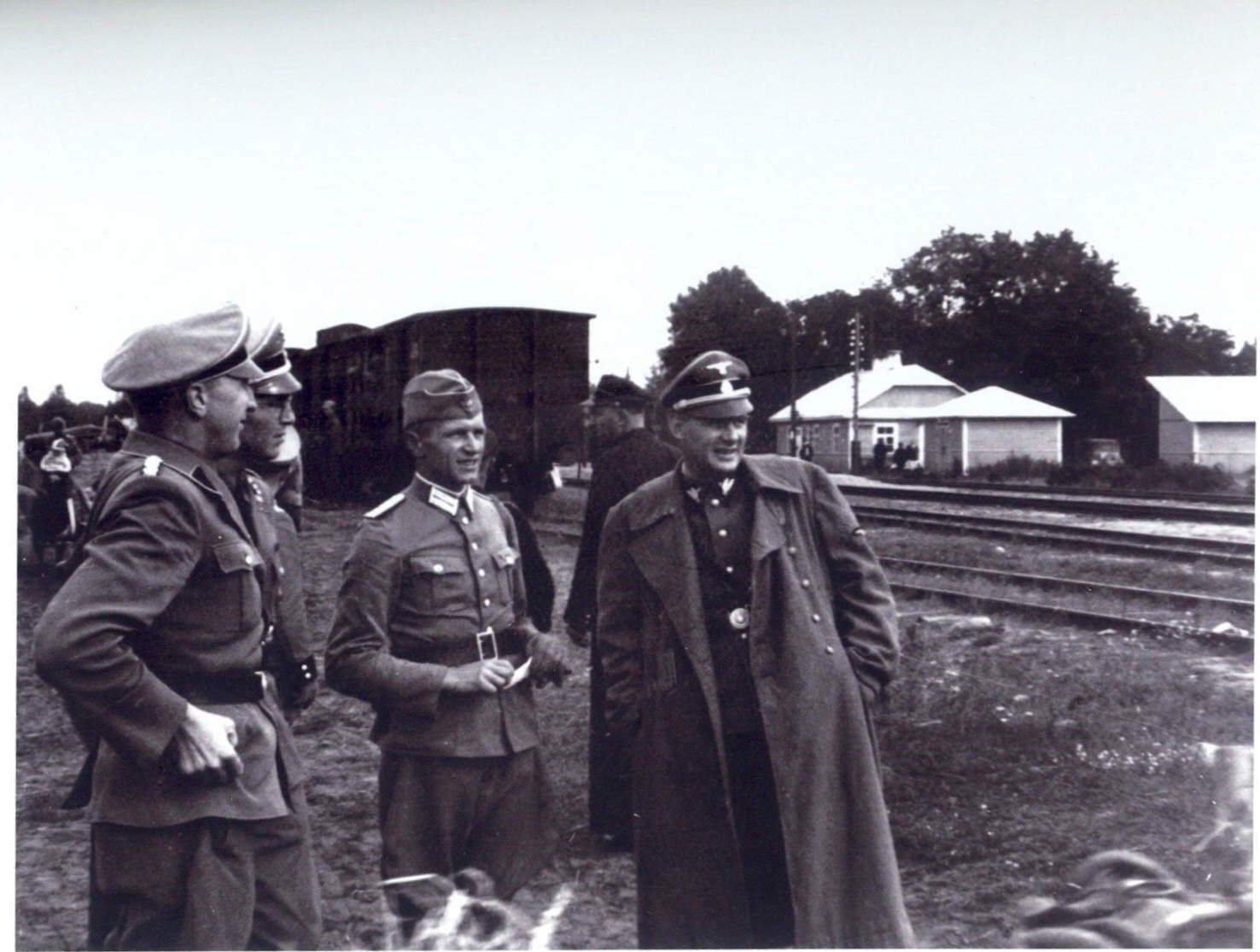
On 19 July 1942, on the eve of the Great Action concerning the Jews of Warsaw, Himmler visited Sobibor, one of the “Aktion Reinhard” death camps in the Lublin area. On the same tour he also visited the SS Training Camp at Trawniki, where a number of photographs were taken.
At the end of July 1942 the deportations to the Sobibor death camp temporarily ceased because of construction work on the Lublin – Chelm railway line, during the next two months only a few smaller transports from some nearby ghettos arrived at the camp. During August 1942 Commandant Stangl was transferred to the Treblinka death camp, and his place was taken by Franz Karl Reichleitner, a former euthanasia colleague, you had served with Stangl in Hartheim.
In all the three death camps, the initial gas chambers capacity were found to be wanting, and Erwin Herman Lambert, and Lorenz Hackenholt after completing the construction of new gas chambers at Treblinka, went to Sobibor.
Erwin Lambert testified after the war:
“It was sometime in autumn 1942 but I don’t remember exactly when. At that time I was assigned by Wirth to enlarge the gassing structure according to the model of Treblinka.
I went to Sobibor together with Lorenz Hackenholt who was at that time in Treblinka. First of all, I went with Hackenholt to a saw-mill near Warsaw. There, Hackenholt ordered a big consignment of wood for re-construction in Sobibor.
Finally, both of us went to Sobibor, we reported there to the camp commander, Reichleitner. He gave us the exact directives for the construction of the gassing installations. The camp was already in operation, and there was a gassing installation. Probably the old installation was not big enough and reconstruction was necessary.
Today I cannot tell exactly who participated in the reconstruction work, however, I do remember that Jewish prisoners and so-called “Askaris” took part in the work. During the time that building was in progress, no transports with Jews arrived.”
The new gas chamber building had six chambers, three on each side of a corridor that ran through the centre of the structure; now 1,300 people could be gassed at the same time. When the construction work on the railway was completed, transports started arriving again, at the Sobibor death camp.
In early spring 1943, Himmler once again visited the “Aktion Reinhard” Headquarters and the death camps of Sobibor and visited Treblinka. In anticipation of Himmler’s visit the camps were thoroughly cleansed.
Karl Frenzel (Sobibor) testified at his trial regarding this visit:
I remember that afterwards all the Unterführer were assembled in the canteen, and Himmler delivered an address to them…” In honour of Himmler’s visit a special gassing of several hundred young Jewish girls took place. This is confirmed by the testimony of SS-Oberscharführer Hubert Gomerski who served at Sobibor: "I remember the visit of Reichsführer Heinrich Himmler in Sobibor, I saw Himmler with the whole group going in the direction of Camp III."
Heinrich Himmler found both camps to be relatively idle, and thus gave the order for transports from Netherlands and France to go to Sobibor.
In March 1943 four transports from France brought 4,000 people to Sobibor, virtually all of those transported were murdered, apart from Joseph Duniec. Nineteen transports arrived at Sobibor from the Netherlands between March and July 1943, carrying 34,313 Jews. In the first two transports passenger trains were used, after the 10 March 1943 cattle wagons were used.
Transports from the Netherlands were greeted by the SS with a polite welcome, in order to allay any concerns the deportees may have, at least during the initial reception phase. Once naked and in the ‘tube,’ no more deceptions were required.
Ilana Safran recalled her deportation from the Netherlands:
“Later we were transferred to Westerbork, the gathering place of Dutch Jews, and we remained there for one week, in April 1943 we left for Poland. The journey to Poland was dreadful; the prisoners from western countries believed that they were going to labour camps.
In 1943 the Poles already knew that Sobibor was a death camp and when they arrived they refused to leave the train. When we reached Sobibor, a selection took place, young girls were placed on one side, the others including children, went to the gas chambers. We were given postcards, “Write to your families that you have arrived safely.” I wrote a card to some Dutch friends, it reached its destination and I found it after the war.”
Of course, given the camps destructive nature, almost all of the Dutch Jews were murdered, only 18 out of the 34,313 Jews survived, most having been selected for labour camps on the Sobibor ramp. The SS administration even encouraged the Dutch Jews to send postcards to Holland, saying they had arrived safely in Poland.
On the 5 July 1943 Himmler ordered the addition of a munitions supply area (Camp IV). Bunkers were built and to improve the camp’s security mines were laid
On the 20 July 1943 the so-called ‘Waldkommando’ (Forest Commando), whose job it was to fell trees for expansion, collecting firewood, and branches for camouflaging the barbed-wire fences, revolted, eight prisoners escaped, all the others were shot.
Kalman Wewerik recalled the event:
“One spring day in 1943 about 30 men of the Waldkommando (forest commando) were taken out, under Ukrainian guards, to work. Later that day we saw the Ukrainians herding a much smaller body of Jews back to the camp.
The Jews were bloodied, in bad shape. They were dragging many corpses with them. We were told that two of the Jews, Kof and Podchlebnik, had asked for permission to go to a nearby well and bring back water for their fellow prisoners. This was around mid-day and the men were thirsty. When they got to the well, they attacked the Ukrainian guard accompanying them, took his weapon and ammunition, tossed him into the well, and took off.
When they didn't return with the water, the other Ukrainian guards became suspicious and herded the remaining Jews together, under heavy guard, until the matter would be clarified. These Jews understood what had occurred; they knew that they were finished whatever would happen. When one or two escaped from a group, the whole group was killed. So these desperate Jews took off in all directions, the Ukrainian guards firing at them and pursuing them.
Some of those Jews were said to have successfully escaped. However, those who were caught alive were brought back, tied up (hands and feet), sat down and ordered to look straight ahead while they were savagely clubbed by the Ukrainians.
We were ordered to stand in a semi-circle and to watch the "spectacle"; we were also ordered to laugh loudly during the ordeal of our poor fellow Jews. These unfortunates, however, had the courage to shout out, while they were being tortured. One, a religious Jew, yelled: "The end of the Hitler is coming!" Another shouted: "Shma Yizroel!" Then the Ukrainians shot them all; one unfortunate had to be shot 3 times before he died. The Ukrainians were foaming at the mouth as they clubbed them. Sobibor was full of those Ukrainians, the henchmen of the SS. For 2 or 3 months after this incident we were tormented and abused even more than usual.”
In July / August 1943 an underground group was formed amongst the Jewish prisoners, under the leadership of Leon Feldhendler, who had been the chairman of the Judenrat in the Zolkiew ghetto.Transports started to arrive from the Reichskommissariat Ostland during September 1943, principally from Lida, Minsk and Vilna. In one of the last transports from Minsk, Jewish soldiers serving in the Red Army were brought to Sobibor from the labour camp in Sheroka Street.
Among the prisoners was Alexsander Pechersky, better known as Sascha, due to his military experience he became the camp’s underground commander, with Feldhendler as his deputy.
Pechersky came up with a simple plan for a mass escape, which involved killing the SS camp staff in a short but sustained burst, and escaping with the onset of darkness. The revolt was planned to occur on the 13 October 1943, but the unexpected arrival of SS troops from the labour camp at Osowa, resulted in a 24 hour delay.
On the 14 October 1943 with Reichleitner, Wagner and Gomerski on leave, the SS garrison were considerably weakened, and now the die was cast. At about 4pm, deputy commandant Johann Niemann visited the tailor’s shop to try on a new uniform. There he was killed by Alexsander Shubayev with a blow from an axe.
Not surprisingly, with such an occurrence, who killed which SS man, when and where is filled with confusion and conflict, whether Johann Niemann or Joself Wolf was the first of the camp staff to be killed.
Yehuda Lerner testified about his part in the uprising:
“My assignment was to liquidate Scharfuhrer Graetschus who was in charge of the Ukrainian guard. I was happy for the opportunity given to me to kill a German.
We had prepared axes which we had sharpened in the smithy. We took up our position an hour earlier. At four o’clock we were sitting in the rooms and waited. According to the plan the first one to arrive was Niemann. He came in time and entered the room where the tailors working for the Germans were sitting.
Five minutes later the German entered that I and my friend awaited, he said that he hoped his winter overcoat was ready. The tailor brought the the coat and started to fit it on him.
It turned out that the German was closer to me than to my friend. I was sitting and sewing a button on a coat for a Ukrainian and the axe was between my legs. I got up, keeping the coat over the axe, approached the SS man from behind and split his head. We put the body beneath the table the tailors were working at.”
The list of Germans killed in the revolt:
SS- Oberscharfuhrer Werner Dubois was also severely wounded in the attack on the armoury, he was hit with an axe and shot in the chest, but he survived the attack.
At that time Sobibor held about 700 Jews, and not all of them escaped, approximately 300 managed to break out to the forest and taste freedom. In the forest they were hunted by SS, Police and Ukrainians, and most of them lost their lives. In addition to this an unknown number of Jews lost their lives to Polish underground groups, who took their money and then their lives.
Those Jews who remained in the camp during the revolt – mainly the religious and foreign Jews, who did not know the language or the country, were killed on the spot. This also included the prisoners in Camp III, who because of their isolation knew nothing about the revolt.
On the 20 October 1943 five cargo wagons left Treblinka death camp to Sobibor with a few dozen Jews and their Kapo Karl Blau, to dismantle the camp. They had been involved in the dismantling of Treblinka death camp following the revolt, in August 1943.
The work took about a month to complete and when this was accomplished the Jewish workers were murdered in the most brutal fashion. Early in the morning of the 23 November 1943, Gustav Wagner announced the final liquidation.
The Kapo Karl Blau and his wife committed suicide the night before, the thirty remaining Jewish workers were forced to lie down on the cremation site consisting of narrow gauge rails, where they were shot in the back of the neck, in groups of five. Gustav Wagner, and the Ukrainians Bodessa and Kaiser played an active role in the executions which took about one hour. The bodies were cremated and along with the cremation rails were buried on the grounds of the former Camp III.
The Germans dismantled the incriminating gas chamber installations and other buildings, but a number of former camp facilities were used by the Baudienst (Construction Service) until July 1944, when the Red Army and Polish forces defeated the Germans.
Most of the barracks were not destroyed by the SS, but rather in the immediate post-war period, the ramp for example was used until 1947 for gathering Ukrainians, who were destined for resettlement to the Ukraine, or to the western parts of Poland. While these Ukrainians waited for their trains, sometimes this took one week, they demolished the remaining wooden barracks for fuel or camp fires.
The large forester’s watchtower was not destroyed because this densely wooded area, needed such a tower for observation, in case of fire. The watch tower collapsed and was removed in 2003. The former commandant’s house, also known as the “Swallows Nest” during the death camps time was also not destroyed, since it originally belonged to the forester’s administration, and was not strictly connected to the mass murder process. As with the other camps, the precise number of victims may never be known, with the discovery of the telegram from Hofle to SS – Obersturmbannfuhrer Heim in Krakow showed the number of Jews murdered in Sobibor up to the year end of 1942 as 101,370.
Official estimates range from 150,000 to 250,000 but Erich Bauer, known as the Gasmeister recalled after the war:
“I estimate that the number of Jews gassed at Sobibor was about 350,000. In the canteen I once overheard a conversation between Frenzel, Stangl and Wagner. They were discussing the number of victims in the extermination camps of Belzec, Treblinka and Sobibor and expressed their regret that Sobibor ‘came last’ in the competition.”
The Sobibor Trial
On 6 September 1965 the German court in Hagen initiated criminal proceedings against twelve former SS men, accusing them of crimes against humanity.
On 20 December 1966, the following sentences were handed out:
Earlier several key SS officers who had served at Sobibor were tried, such as SS-Oberscarfuhrer Hubert Gomerski, who was arrested but acquitted in a 1947 euthanasia trial. When his participation in the crimes committed at Sobibor were proven, he was sentenced to life imprisonment on 25 August 1950.
SS- Untersturmfuhrer Johann Klier was arrested, but based on the testimony of Sobibor survivors, that Klier was a person who felt compassion for the Jews and secretly tried to help them, he was released.
In the 1965/66 trials the accused claimed that once assigned to serve in a death camp, there was no way out, citing the statement made by Christian Wirth, to the personnel at Sobibor, “if you do not like it here, you can leave, but under the earth, not over it. However, Klier who asked to be transferred from Sobibor was not killed but allowed to leave.
One of the worst murderers in Sobibor was SS-Oberscharfuhrer Erich Bauer, the gas chamber “meister”, was recognised on the streets of Berlin, by survivor Samuel Lerner. On 8 May 1950 Bauer was sentenced to death, but this was commuted to life in prison, as the death penalty had been abolished.
Bauer died in the Tegel prison in Berlin 1n 1980.
Werner Dubois admitted during the trial his guilty part in the extermination of the Jews, his court testimony at Hagen read:
“It is clear to me that in the extermination camp, murder was committed. What I have done was only to assist in the murder. If I were to be found guilty it would be justified, murder is murder. We are all guilty."
"The camp had a chain of command and if one link in the chain were to refuse to co-operate then the whole system would collapse. We did not have the courage to disobey orders.” A few of the Ukrainian guards who served at Sobibor were brought to trial in the Soviet Union, such as:
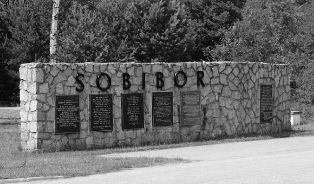
They were found guilty and executed for their crimes. In 1961 a first memorial was built, today a fine memorial and small museum and a church stands on the site of the former Lazarett,and five plaques, stating that 250,000 Jews were the victims of Sobibor.
The unloading ramp was used until 1960 but all railway traffic ceased in 1999, the Sobibor station now stands idle.
Sources:
Sobibor Martyrdom and Revolt, by Miriam Novitch, published by Holocaust Library New York 1980 Inferno in Sobibor, by Shlomo Szmajzner Sobibor - The Forgotten Revolt, by Thomas Tovi Blatt published by H.E.P 1998 Those were the Days, by Ernst Klee, Willi Dressen and Volker Reiss, published by Hamish Hamilton London 1991 Kalman Wewerik – Report Schelvis, J. Vernichtungslager Sobibór, Metropol Verlag, Berlin, 1998 Archives of Wlodawa and Sobibor Museums Bundesachiv Ludwigsburg Extermination Camp in Sobibor by Robert Kuwalek, published by Zeszyty Majdanka Vol XX1 – 2001 Vernichtunslager Sobibor, by Jules Schelvis, published by Metropol Verlag Berlin 1998 Holocaust Historical Society
Copyright Chris Webb, Carmelo Lisciotto, Victor Smart 2009 H.E.A.R.T
|


sm.jpg)
%20sm.jpg)

.jpg)
.jpg)