Holocaust Education & Archive Research Team |
|
Occupation German Occupation of Europe Timeline
-
[The Occupied Nations]
Poland Austria Belgium Bulgaria Denmark France Germany Greece Hungary Italy Luxembourg The Netherlands Norway Romania Slovakia Soviet Union Sudetenland | ||||||||||
The Destruction of the Jews of France
Hitler who had not expected to conquer France and the Low Countries in six weeks, tackled the problems of occupation as they came without preconceived ideas.There were no demographical plans for the shifting of populations, as in the case of Poland, and for a time France was scarcely considered in connection with the Jewish problem in the light of National Socialist theory.
With France divided into two zones the Occupied area and Vichy, Hitler intervened in an action that treated the Vichy zone as a dumping ground for unwanted Jews from Germany.
However, this spurred the Reich Main Security Office (RSHA) now tried to bring the Vichy Government into line with the regulations as enforced against the Jews in the Reich.
Joyfully seconded by Ambassador Abetz and his diplomatic assistants, Schleier and Zeitschel, Heydrich began to install the machinery of the “Reichsvereinigung” and the “Judendezernat”, that is to say a single body to represent all Jewish interests, handcuffed to a special police department, through whom alone the authorities could be approached.
This was the classic model, evolved by Heydrich and Eichmann in Vienna and Prague. In France that result was never achieved and, because of it, less than 62,000 out of a possible 300,000 Jews were deported in the course of the war. This was only the mechanical reason for the failure, the mechanism broke down because of its psychological unsuitability, it took the Gestapo a very long time to learn that the most collaborationist French officials persisted in regarding a French – born Jew, and even a naturalised Jew, as a Frenchman.
It is nevertheless true that, in the bargaining game to which they were forced, the Vichy Government were always prepared to sacrifice the stateless or refugee Jews from the Reich and Poland.
Thus, while less than a tenth of the Jews who were deported possessed French nationality, most of the refugee population were exterminated. The refugees unfortunately lent themselves to this discrimination. Having lived largely on Jewish charity, they were deprived of their source of supply by the flight of wealthy and influential native Jews in the summer of 1940.
It was easy for the Gestapo to gather up the shreds of the welfare organisations so as to make another “Reichsvereinigung”, but this writ did not extend beyond the stateless Jews.
The French Jews retained some means of livelihood, they were at home, some had Aryan friends and they were debrouillards. They could even escape identification by the Gestapo’s “physiognomy brigade”.
When the Gestapo created a co-ordinating committee for the Jewish relief organisations – the traditional first step towards a Jewish Council or Judenrat – they had to appoint as directors two Jews living in Vienna and the committee was boycotted by French- born Jews.
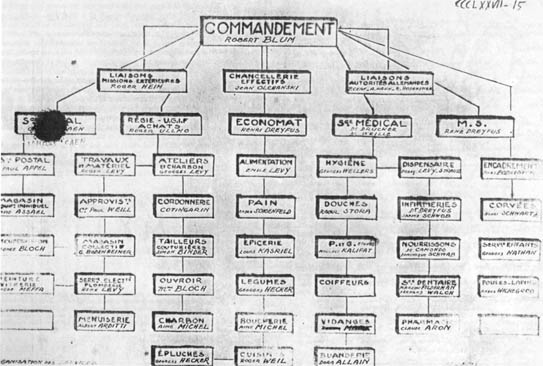
Late in 1941, the co-ordinating committee of the two zones were amalgamated as UGIF – Union Generale Israelite Francais. This did not mean that the UGIF became a Judenrat in the East European sense, though in December 1941, the Paris branch had to aid in collecting the 1,000 million Franc fine and, at the time of the deportations, it distributed relief from Jewish assets confiscated by the Germans. But UGIF never sponsored a Jewish police force to arrest Jews, not even in July 1943, when Anton Brunner sent his Jewish decoy-gangs from the transit camp at Drancy.
A brief explanation on Drancy might be helpful:
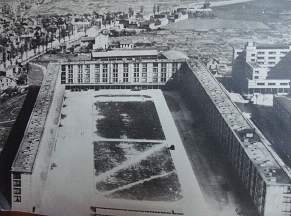
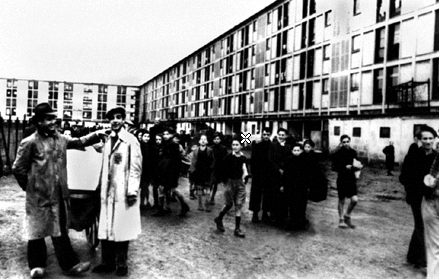
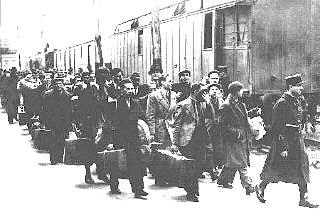
Drancy was used as an Assembly Camp / Sammellager from August 1941. The camp was located in a public housing project built between the years 1932 to 1936, and the project was known as Cite de la Muette. It was used for its intended purpose prior to the Second World War, but was later used as a barracks for French police and then a transit camp for the Jews of France.
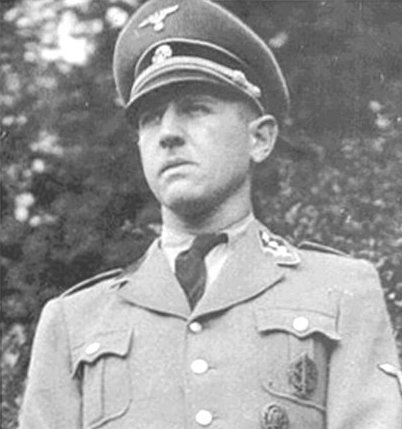
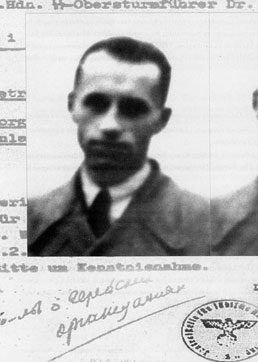
The camp measured 200 by 400 metes with barbed wire fences and watchtowers at each corner, the camp could hold some 4,500 prisoners and was guarded initially by French police, then the SS took over the camp on 2 July 1943. The commandant was Alois Brunner, one of Eichmann’s top agents, assisted by four other SS members of Eichmann’s staff.
65,000 people passed through Drancy, being taken by bus to the nearest railway station of Le Bourget- Drancy to death camps in Poland. In 1976 most of the complex was destroyed, only the large courtyard block that served as the Assembly Camp can still be seen today.
If the Germans failed to create an effective ghetto system in France, they failed equally to create a French Inquisition of any consequence. The Commissariat aux Questions Juives was never sure of the support of the Vichy Government, and its police obtained less and less cooperation from the regular gendarmerie.
Yet it was essential to the Germans that the Jews should appear to have been arrested and deported by Frenchmen. In the first flush of victory the Germans had little reason to doubt that they would obtain this compliance from the conquered. The Vichy Government readily produced the “Statut des Juifs” of 4 October 1940, by which refugee Jews who had been deprived of their German nationality forfeited all civil rights.
It enabled 40,000 Jews in the two zones to be put in internment camps. Morever it forced the Vichy authorities to intern the German Jews who were dumped on them by Heydrich eighteen days later.
It appeared that the French ministers could now be trusted with the entire gamut of destructive measures against Jewry. Flushed with this success, a brutal thug in Heydrich’s Security Police, Sturmbannfuhrer Lischka, proposed at a military government conference in Paris that only the French should be allowed to create a Central Office for the Jews, because of “the reaction of the French people to everything that comes from Germany.”
When it was suggested during this month of February 1941, that Otto von Stulpnagel, the military commander, should be asked to authorise the internment of the remaining refugees, Eichmann’s agent, Theodor Dannecker, argued with Abetz that “legal supplementation from Vichy would be needed.”
However, on 6 March 1941, Abetz informed Ribbentrop that Petain, was far from sharing the enthusiasm for these measures which had been attributed to Admiral Darlan, the second head of the State. Having interviewed Xavier Vallat, the former secretary-general of the Legion de Combattants, whom the Vichy Government had appointed as its first Commissary for Jewish Affairs, Abetz decided that there would be heavy resistance to any new laws which would lead to the emigration of French Jewry.
Later Dannecker was to declare that Vallat did not hide his partiality even for “acclimatised” foreign Jews, and that the arrest of 3,600 naturalised Polish Jews on 14 May 1941, had created more stir in Vichy circles than the arrest of 30,000 unwanted Jews from the Reich at the end of 1940.
Hauptsturmfuhrer Theodor Dannecker, the author of this report of 1 July 1941, was a lawyer of the least possible consequence, so obscure that end of the war no one knew his identity. For twenty years Dannecker was considered missing – only in the 1960’s was it known that he had hanged himself, while a prisoner of the Americans at Bad Tolz in 1945.
Most of the information he collected for Heydrich was puerile, yet Stulpnagel, Rosenberg and Abetz agreed to send representatives once a week to 72 Avenue Foch, with orders to confer with this nonentity.
Such was the awe with which the highest officials then regarded the Gestapo. Otto von Stulpnagel, the military commander did, however, put up a little resistance. It was not till December 1941, that he authorised any deportations of Jews from France, and then only in the disguise of a reprisal measure, for France differed from the rear areas in Russia in that the German Army had not surrendered its rights to the servants of Himmler and Heydrich.
Nothing less than a head-on collision between Keitel and Heydrich was necessary before the “SIPO and SD” could assert its full competence to handle Jewish affairs in France.
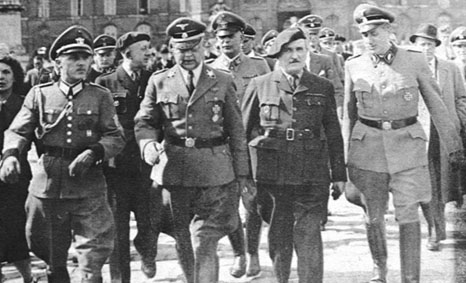
This collision began with a thoroughly ludicrous story – on the night of 2 October 1941, an amateurish attempt was made to blow up two Paris synagogues. The commander of the Security Police and SD in Occupied France was Standartenfuhrer Helmuth Knochen, a former Gestapo spy who, having been employed in watching Jewish refugees in Holland, had assisted in the kidnapping of Captains Best and Stephens at Venlo in November 1939.
Knochen sent a report to Stulpnagel, from which it appeared that the explosions were the work of French fascists and that the French police suspected Eugene Deloncle, the leader of a so-called Social Revolutionary Movement.
Yet Knochen sent his report, knowing that a certain Obersturmfuhrer Sommer of his commando was under open arrest, Sommer had boasted of the explosions to two French Gestapo informers while drinking in the “Cabaret Chantilly”.
This led to a court of inquiry on 5 October when Sommer admitted having supplied the explosives to Deloncle and his assistants – all of them Gestapo informers.
Sommer’s case was referred to the Main Security Office in Berlin and a report was sent to Stulpnagel, but it was from another member of the court of enquiry that Stulpnagel learnt unofficially that Sommer had pleaded he was under orders from Knochen.
On the 6 October, therefore, Stulpnagel complained to Keitel, as head of the High Command of the Armed Forces, that the SS were increasing his difficulties with the French, which were already bad enough on account of “the necessary shooting of hostages.”
Knochen, against whom Stulpnagel repeated his charge of forging a report, was sent for by Heydrich, and on 22 October Keitel demanded not only Knochen’s recall, but also that of Brigadefuhrer Thomas, the Higher SS and Police Leader for the occupied Western countries.
On 6 November Heydrich replied to Keitel through Quartermaster – General Wagner:
“It is important to demonstrate to the world that the French nation has the necessary strength to fight the Jews and Communists. Deloncle seemed to me the best instrument, in spite of his ambiguous political record.
My Director of Services did not think it necessary to tell Stulpnagel, because our experience gave little hope of his comprehension. I was fully conscious of the political consequences of these measures, the more so since I have been entrusted for years with the task of preparing the final solution of the Jewish problem.”
Heydrich then went on to inform Wagner that he had transferred Sommer to Berlin, but that Knochen would continue to direct “Action – Group France.”
As to Brigadefuhrer Thomas, he had already transferred him to Russia, in fact Thomas had replaced Otto Rasch of Einsatzgruppe C in Kiev. Stulpnagel still demanded Knochen’s recall, and Wagner reminded Heydrich of an agreement by which “special commandos” of the Main Security Office had to accept the orders of the military commander in France.
Heydrich’s reply cannot be traced, but we know that on 5 February Stulpnagel withdrew his complaint against Knochen, “because he had expressed his willingness to cooperate.” But if Knochen commanded the Security Police in France right up to the Allied liberation, it was precisely because he did not put himself at the disposition of Stulpnagel.
Furthermore, the new “Polizeifuhrer West” Brigadefuhrer Karl Oberg, who arrived in Paris from Radom, in Poland, on 7 May 1942, was completely independent of Stulpnagel and took his orders direct from Himmler.
Unlike his kinsman, Heinrich von Stulpnagel who succeeded him early in 1942, and who was capable of denying Knochen the use of military personnel, Otto von Stulpnagel worked henceforward in close harmony with Heydrich’s SD men.
The proposal which the Military Commander made to Keitel on 5 December 1941, must have been all that Heydrich desired, namely that he should have authority to execute a hundred hostages as a reprisal for three recent attacks on German soldiers.
Stulpnagel also proposed that the Paris Jews should pay a fine of 1,000 million francs, and that a thousand Jews and five hundred Communists should be deported for forced labour in the East.
Hitler, to whom this was referred, was sly enough to order that the plan should be carried out with the co-operation of Abetz, who had a French wife. Abetz in a tremendous panic, at once telephoned the Foreign Office to make sure that the hostages were described not as Frenchmen, but as “Soviet and Secret Service agents of Judeo- Communist and de Gaullist origin” – which happy phrase was conveyed to the Vichy envoy, de Brinon by Stulpnagel on 21 December, with the news the deportations were being executed.
Actually the news was premature- although 753 Jews had been rounded up in Paris on the 12 December and taken with 355 more Jews from Drancy to the Compiegne camp, word arrived from Heydrich on the 24 December that the Wehrmacht Transport Command had banned extra traffic across the Reich during the Christmas leave period.
As a consequence, the Paris Jews, who might have gone straight to Heydrich’s death pits at Riga, or Kovno, were partly set free and partly reserved for Auschwitz. Dannecker tried to press Eichmann on 28 February 1942, for a positive date, but failed to get one. The first Auschwitz transport did not leave Compiegne till 28 March 1942
Since the Gestapo had concentrated on the arrest of rich foreign Jews and intellectuals, Heinrich von Stulpnagel ruled that only the medically fit between the ages of 18 and 55 should be deported.
Thus only half the 1,098 Jews who had been detained at Compiegne since 12 December 1941, ended by boarding the Auschwitz deportation train. Another 550 had therefore to be chosen from Drancy transit camp.
In Compiegne, moreover, some 97 victims of the round-up died, from the hardships of the place in the course of fifteen weeks, and fifteen were released early on.
On this occasion the Jews travelled to Auschwitz in passenger coaches. Dannecker had expressly asked Eichmann’s transport officer, Obersturmfuhrer Franz Nowak, for goods vans, but all the vans available were reserved for Russian civilian workers.
The Gestapo disliked passenger coaches because they made observation difficult. With the arrival of the train at Auschwitz on 30 March 1942, the first 1,112 deportees from France disappear from view, they are all gassed.
Dannecker, who visited Eichmann in Berlin on 3 March 1942, claimed the credit of being the first to propose continuous Jewish deportations from France.
On 9 March Eichmann informed his faithful Foreign Office stooge, Franz Rademacher that the immediate number would be 6,000. Rademacher replied on the 20 March that neither the Foreign Office nor the German Embassy in Paris objected to 6,000 Jews whether French or stateless, going to the concentration camp Auschwitz.
Rademacher’s reply was countersigned by Ernst von Weizsacker, the First Secretary of State, who wrote in the margin words that seem somehow intended to wash his hands of the whole affair: “Polizeilich naher charakterisierbare – to be characterised more closely as a police matter.”
The Foreign Office mandate to Eichmann with Weizsacker’s approving rider was responsible for the deportation trains which left Drancy for Auschwitz on 29 April and on 1, 6, 22, 28 June 1942.
In these trains were packed more than 5,000 men and women. The arrival of two of the trains at Auschwitz – Birkenau was noted by Dr. Vrba, in his smuggled report of 1944. The other transports probably went to Majdanek concentration camp.
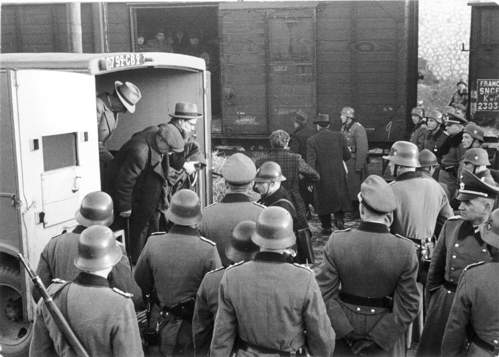
The selections were made at Drancy, in the four hideous skyscrapers of the “cite ouvriere” – Jewish camp orderlies approved by Dannecker’s staff made out the lists and Dannecker himself saw the transports off, “with a nervous twitch and ill coordinated movements which at a distance resembled those of a drunken man.”
At this period there were many exempted classes in Drancy, not only French Jews and those with French wives, but Jews from countries which were not yet included in the deportation plan- furthermore, the old and unfit and the children were still protected from the Auschwitz gas chambers, though not for long.
According to Dr Vrba’s report, the first direct selection took place when the Drancy train of 22 June reached Auschwitz station. There two hundred Jews were picked for the gas chambers, and eight hundred for the camp.
But already the Germans had taken a step towards a far more radical deportation policy, which was to include French-born Jews, irrespective of political associations or hostage value.
A conference of experts on Jewish affairs from the various Ministries met in Eichmann’s office on 4 March 1942, Eichmann proposed extending the badge, worn by the Jews of Poland since 1939 and by the Jews of the Greater Reich since September 1941, to the Jews of all Occupied Europe.
Himmler thereupon instructed Knochen, who convened a conference on 14 March, where he obtained the concurrence of the Military Government in Belgium and the Civil Commissariat in Holland, but the Vichy Government was not brought into line so easily.
The chief obstacle was Xavier Vallat, who had just put the insignificant Dannecker in his place and whom de Brinon described to Abetz as “the Commissary for the Protection of the Jews.”
So great was Vallat’s resistance to the Jewish badge that at the end of the month , Abetz secured his replacement Abetz thought that the new Commissary d’ Arquier de Pellepoix, would get the Jewish badge decreed in the Free Zone within a few weeks, but Dannecker wrote in the margin of Abetz’s memorandum “too big an optimism” – and Dannecker was right.
The Jewish badge could not be enforced in Vichy territory even after 11 November 1942, when it ceased to be a free zone. On 17 April 1942, the new Commissary reported that the Vichy Government would do nothing about a Jewish badge without an order from Stulpnagel, but Abetz was still manoeuvring to get the Vichy Government to publish the decree before the Germans did. On 4 May 1942 Abetz resigned himself to publishing the German decree for the Occupation Zone forthwith, having been impressed by “the part that the Jews had played in the Communist riot at Argenteuil.”
Thereupon, as was his habit, Heydrich having gained a point, demanded another – he summonsed Knochen to Prague on 18 May and told him the French half-Jews must wear the badge too. But before the incredible difficulties of the new order could be studied by the recently arrived and still bewildered Oberg, Heydrich was stricken down, and on 4 June 1942 he was dead.
With a long schedule of diplomatic exemptions, which included British and American subjects, Brigadefuhrer Karl Oberg published the Jewish badge decree for Occupied France on 1 June 1942.
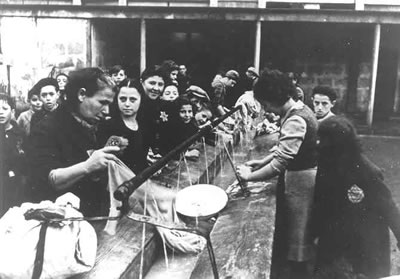
The badge had to be worn from the age of six upwards, and a clothing coupon had to be surrendered. The decree was received in a light-hearted manner initially and some young French men and girls wore the badge out of sympathy and in order to give the Security Police trouble.
Knochen complained on 10 June of Jews who flaunted their badges in cafes and restaurants frequented by the German army, and of Jewish ex-soldiers who wore the badge below their decorations.
Even more satirical matter was provided by demands for exemption, Petain asked de Brinon to intercede for a Marquise and two Countesses, to which modest list he later added the husband of the novelist Collette and the widow of Professor Bergson.
De Brinon himself had to seek the protection of the Gestapo for his own wife, who received her exemption in person from the hands of Sturmbannfuhrer Hagen of “the commando.”
Six Jews were exempted because they worked for d’Arquier’s anti-Jewish police and one because he worked for Schellenberg’s secret service.
The real implication of the badge was not unappreciated, since Dannecker complained on 19 June that only 83,000 out of 110,000 Jews officially at liberty in the Occupied Zone had applied for it.
Stulpnagel’s next decree dated 8 July could not have been quite unforeseen. It entitled the Gestapo to make any public place out of bounds to badge wearers. The list, published on 15 July, was so big that there was little a Jew could do except walk the streets. Even the shops were only available to Jews between three and four in the afternoon.
The purpose was of course to facilitate a general deportation. On 11 June 1942 Dannecker told his colleagues from Brussels and The Hague that the French quota for the next three months was to be 100,000 Jews from both zones, all to be sent to Auschwitz.
Eichmann had promised three trains a week after 13 July – five days later, Dannecker learnt that a Jewish deportation programme which required 120 box-cars, was out of the question, because Fritz Sauckel, the chief of the forced labour programme, had priority for 350,000 French workers to be sent to the Reich.
In any case, the order had been misunderstood; Eichmann had instructed Rademacher that the French quota was to be 40,000 Jews.
Dannecker was disappointed on other counts. On 25 June he told Jean Leguay, who represented the Vichy Ministry of Police in Paris that a date must be set for the round-up of 22,000 Jews in Paris and 10,000 in the Free Zone.
Leguay hedged. It would take his Government more than three weeks to locate 10,000 “undesirables” and it would need at least 2500 police.
The chief of d’Arquier’s private police told Dannecker that Rene Bousquet, the Vichy Minister of Police, would have nothing to do with deportations.
But from Heinz Rothke - who was about to be promoted over his head – Dannecker learnt that Bousquet’s real attitude would not be known till after Laval’s visit to Oberg in two days time. Laval was then to be persuaded to give d’Arquier full powers over Bousquet and the gendarmerie.
Eichmann still complained of “the ever increasing obstacles” of Vichy. Yet when the meeting took place, Laval showed himself unusually accommodating – perhaps because Abetz had provided his Legation Counsellor, Rudolf Rahn to muffle Oberg’s mailed fist.
Although for the moment Laval would only consent to the deportation of foreign and stateless Jews, he promised later to revise the naturalisations, granted to Jews since 1927 and even since 1919.
Laval was also willing to deport children under the age of sixteen from the Free Zone – children in the Occupied Zone -”did not interest him.” Here one suspects that Laval was deliberately using the language of the Gestapo. In his own account of the meeting, Laval glosses over the revocation of the naturalisations. He had achieved his triumph, the exclusion of the French-born Jews, but at the price of promising the help of the French gendarmerie.
This was not good enough for Himmler and Muller, within four days the bustling Eichmann was in Paris. Knochen and Dannecker must see to it that Laval renounced his rights over the French Jews deported from the Occupied Zone. They must demand the “indispensable legal basis whereby the French Jews became stateless the moment they crossed the border.”
“A delay in this matter would involve considerable inconveniences in foreign policy, inconveniences which the execution of the Reichsfuhrer’s order must avoid at all costs.”
This sentence in the joint communication sent by Eichmann and Dannecker to Abetz and Stulpnagel is surely from the pen of Eichmann. It reveals the cautious Nazi bureaucrat, whom Eichmann’s friend, Wisliceny, so precisely described at the Nuremburg War Crimes Trial.
Extremely ambitious plans were drawn up during Eichmann’s visit to the “Kommando”, deportation trains were to run from Bordeaux, Angers, Rouen, Chalons, and even a train from Marseilles which was to take Jews ferried from Algiers, but the appearance of d’Arquier and Bousquet at 72 Avenue Foch, three days later was less satisfactory.
Petain and Laval had recommended to the Conseil de Ministres an immediate deportation of stateless Jews in Vichy territory, but Bousquet, the regular policeman, had passed the responsibility entirely to d’Arquier, the terrified amateur.
Dannecker would not be put off by Bousquet’s assertion that a new registration of Jews was needed. The quota of 10,000 Jews for the great round-up, due on 13 July 1942 could be obtained, he said, from the Free Zone internment camps, without going to all the trouble of a general registration. Thereupon, but very reluctantly, Bousquet agreed to Dannecker inspecting these camps himself. Dannecker concluded his report to Knochen on a note of triumph:
“I told him that it was not to be supposed that Germany found it easy to welcome so many Jews, but we were determined to resolve this problem for Europe in spite of all the difficulties.”
Dannecker, having been allowed to see for himself, found the reports of the Vichy arrests which had taken place in 1940 grossly overrated. The three main camps of Les Milles, Gurs and Riversaltes contained less than 6,000 Jews.
In the course of this uncongenial excursion which lasted from 11 July to the 19 July 1942, Dannecker found the Casino at Monte Carlo full of Jews, while at Perigueux, someone with more accuracy than prudence called him a sale Boche.
Furthermore, during his absence, Heinz Rothke, a barrister of the Berlin court and a new boy at 72 Avenue Foch, was promoted to be head of the Jewish Office. Before proceeding to the Free Zone, Dannecker held another interview with Bousquet and d’Arquier who brought along seven Vichy Police officials. Dannecker was assured that 28,000 stateless Jews still possessed registered addresses in Paris.
Convinced that he could count on arresting 22,000 of them, he chose the Velodrome d’Hiver, a sports stadium on the Boulevard de Grenelle, as a place big enough for a collection centre. At this interview the Vichy officials agreed that the deportation trains should be guarded as far as the German frontier by French gendarmerie, in conjunction with the German regular police.
It is regretted that ordinary French policemen performed the main tasks of the round-up, which would not have been possible without them. From the beginning of 1943 it was a different story – the French people were then beginning to feel their strength. Still there was much non-collaboration, even though Rothke, who was more intelligent than Dannecker, postponed the grand rafle to 16 July 1942, in order to avoid the repercussions of the national holiday, the Quatorze Julliet. Rothke complained to Knochen that only half the numbers had been obtained, that the population had shown sympathy with the arrested children, and that the French police warned the richer Jews in time.
The number arrested, including a fair proportion who had to be released, was not 22,000 but 12,886 of whom only 3,000 were grown men, while 4051 were children. About 6,000 were sent direct to Drancy, while 6,900 were collected at the Velodrome d’Hiver, including all the children. It took five days to empty the Velodrome d’Hiver.
To pen people like cattle for days on end without food or water, without any of the comforts of existence and sometimes without a shred of clothing, had been the practice of the SS and German police in Poland for the past four months and in Russia for the past year.
The ordeal of the Kiev, Lvov and Lublin ghettoes was now repeated in the most civilised city in the world. Andre Bauer, the President of UGIF for the Occupied Territory, reported that it took him twenty-four hours to get Rothke to the stadium, where there were only two doctors, no water except from a single street hydrant, and only ten latrines for 6,900 people.
After Rothke’s visit, some pregnant women and disabled ex-soldiers were released, but there were several births in the stadium, besides numerous attacks of insane frenzy and thirty deaths. On the last day the mothers were separated from their children, never to see them again.
Among all the unspeakable things of the Second World War, the story of the 4,051 children in the Velodrome d’Hiver takes a very high place.
Knochen and Rothke conferred with the Vichy officials about them on the second day of the round-up, d’Arquier wanted to send them to orphanages, but the Gestapo wanted them to accompany their parents to the deportation camps at Pithivers and Beaune la Rolande, pending a decision about them from the Security Office in Berlin.
On the fourth day of the inferno in the Velodrome d’Hiver, Eichmann, a model Nazi bureaucrat and the father of three small children, telephoned Rothke from Berlin. There would be enough trains by the end of August to take all the Velodrome children to the General Government.
So the children were separated from their parents and taken to Drancy. At the next conference at Avenue Foch on 13 August 1942, Leguay agreed that 300 to 500 children might be mixed with each Auschwitz transport at once, and in fact they were mostly deported from Drancy before the 30 August.
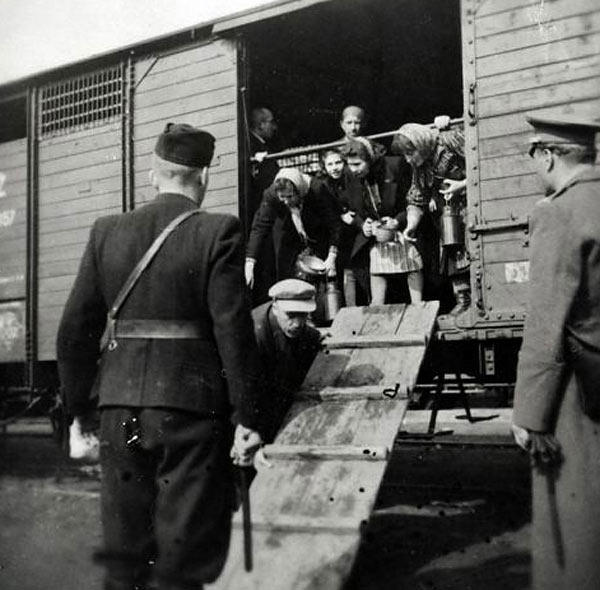
Till then, the women internees tried to look after them as best they could in bare and vermin – filled rooms. No attendants went with the children in the sealed boxcars, filled at that time with the old, the sick and the dying, but somehow they had to be got on the trains.
Dr Georges Wellers, a survivor of Drancy and Auschwitz recalled the scenes:
“On the day of the deportation the children were usually woken at five o’clock in the morning and dressed in the half –light. It was often cold at five o’clock in the morning, but nearly all the children went down to the yard very lightly clad. Suddenly roused from sleep, ill with sleepiness, the littlest ones would begin to cry, and one by one, the others followed their example.
They did not want to go down to the yard, struggled and would not let themselves be dressed. Sometimes it happened that a whole roomful of a hundred children, seized with panic and unconquerable terror, no longer responded to the comforting words of the adults who tried vainly to get them to go downstairs.
Then the gendarmes were called, who carried the children down, screaming with terror. In the yard they waited to be called - they often answered wrongly when their names were called out. The older ones held on to the little ones’ hands and would not let go of them.
There was a certain number of children in each transport added at the end. Those whose names were unknown were entered on the list by a question mark. It was of no great importance – it was doubtful whether even the half of the unfortunate children would withstand the journey.
There was no doubt at all that the survivors would be exterminated shortly after their arrival. In this way 4,000 children, who had been left behind by the evacuation of their parents, were deported in two weeks. "
This took place in the second half of the month of August 1942. In Roethke's deportation file there was found an illicit tract, dated 11 November 1942, it reported that in the box cars returning empty from Auschwitz, Belgian railwaymen had found twenty-five bodies of children aged between two and four. These had never reached the gas chamber.
The vengeance of outraged humanity is seldom spectacular, only Eichmann has been hanged, Muller and Dannecker committed suicide, while Knochen and Oberg spent nearly eighteen years in internment camps and prisons before they were freed.
However, Rothke, the squalid engineer of human misery, has not received any punishment for this truly dreadful crime. The Auschwitz trains ran almost to the time-table after the great round-up, eight between 19 July to the 31 July and thirteen in August.
The Gestapo figures that have survived show that the trains averaged a thousand passengers each, though they might vary as much as from 948 to 1089. Since the number of daily registrations of new arrivals in the camp is known from the Birkenau Appell roster, it is possible to see the tragic results of the grand rafle. Thus, a transport which left Pithiviers on the 18 July, delivered 560 Jews in the male and female camps, the other 440 people were killed in the gas chambers.
By contrast, the train which reached Auschwitz on 16 August 1942, when the last of the children collected at the the Velodrome d’ Hiver, and then onto Drancy, brought 991 Jews. Out of this transport 115 men were admitted into the camp, the other 876 people were killed in the gas chambers. By the end of August 1942 25,000 Jews had been deported from France, but none from the Free Zone and very few from the provinces.
On 14 July Rothke cancelled the train from Bordeaux because the French police, who arrested only stateless Jews, could not collect more than 150. Eichmann was most indignant, after all the trouble he had taken with the Ministry of Transport. Such a thing had never happened to him, “it was reprimand able.”
He did not want to pass the matter to Obergruppenfuhrer Muller, because he would be blamed personally, but he wondered whether he should give up France altogether as a base for deportations.
It was this sort of despatch which caused the figure of Karl Adolf Eichmann to assume an exaggerated importance in some of the Nuremberg documents – no one could seriously believe that this industrious rodent was in a position to stop the deportations personally. He might on the other hand recommend it to Muller, and who knows what would happen next?
Almost certainly this touch of arrogance was inserted as a hint to Rothke that his job was in danger. In September 1942 the team at 72 Avenue Foch had to redouble their efforts to get more Jews out of the Free Zone. On 13 August 1942 they had again learnt that the Vichy Government had ordered a general round-up, but another thirteen days passed before there was any concerted move against the stateless Jews in Free Zone.
Jean Leguay now complained that his unprofessional colleague d’Arquier had given the show away to the Paris press. Nevertheless, 7100 stateless Jews were arrested. By 3 September 1942 the number deported to Drancy from the Free Zone was still only 9,000, but Rothke wrote that a train would be running to Auschwitz every day by the 15th.
He hoped to deport 52,000 more Jews from France before 30 October 1942 when the Reichsbahn would have to withdraw the rolling stock. However, to make up this figure, the Vichy Government were expected to revoke the Jewish naturalisations granted since 1933, and their failure to do so was reflected in the actual numbers, thirteen trains in September and none in October.
There was one consolation for Rothke, on 23 September he triplicated a telegram to Eichmann, Glucks, and Hoss, the Auschwitz Commandant, stating “The brother of Leon Blum, the former French President of the Council, was included in today’s deportation.”
Rothke had now to bargain frenziedly in order to get the naturalisations revoked – in August he had gone so far as to offer immunity to French-born Jews in the Occupied Zone if the post 1933 naturalisations were legally withdrawn.
The terms of a decree were drawn up by d’Arquier and – so Rothke was told – submitted to Laval. At intervals in the next twelve months Rothke pressed Knochen for action, reminding him that Laval had approved d’Arquier’s draft.
Finally on 14 August 1943 Rothke managed to obtain an interview with Laval himself. During those twelve months, the Germans had occupied the Free Zone, but on the other hand the Germans had been driven out of North Africa, Sicily and most of Southern Russia. Rothke, moreover, was not in Laval’s eyes a German of consequence.
All this conspired to make Laval less accommodating that he had been when he made his proposal to Rahn and Oberg. He told Rothke that Petain was disgusted with Bousquet and d’Arquier for drawing up a decree denaturalising women and children. Laval then told Rothke casually that he had lost his copy of d’Arquier’s draft. Before a new draft could be submitted to the Conseil de Ministres, three months must be allowed to enable Jewish objections to be lodged, even though only thirty Jews might have the right to do so.
Until it was done, Laval warned Rothke, the French police could not assist Knochen in his round-ups- and then there were the Italians to be consulted. After this extremely unpleasant interview, Rothke had to report to Knochen that he would need more German police. The full tide of obstruction was yet to come, on the night of 7 November 1942, the Allies landed in French North Africa.
On 11 November 1942 Admiral Darlan, having joined the Allies in Algiers, invited the Toulon fleet to sail. The Germans at once occupied the Free Zone – but since this could only be done with the agreement of Germany’s ally, the Italian army occupied Nice, Grenoble and the Alpes Maritimes.
In this way the blow to Jewry in the former Free Zone was mitigated. The round-ups by the German Security police in the former Vichy towns were so disappointing that only six trains left Drancy for Auschwitz that November.
The Gestapo believed – and with some reason – that most of the Jews had fled to the Italian area. For already in Tunis, Greece and Croatia the Italians had established a reputation for humanity towards the Jews, and even in France they had succeeded in opposing the deportation of Italian Jewish subjects.
On 4 December 1942 Mussolini’s Government became party to a German order expelling all Jews from French coastal and frontier areas. The Italian military leaders interpreted this order as applying to French Jews but not to Italian and other foreign Jews, whom they considered to be under their protection.
Consequently on 29 December 1942, the Italian Armistice Commission made a formal protest to the French Government concerning an order of the Prefect of Alpes Maritimes which banished all Jews to the German Zone.
Laval’s response was to send was to send Ribiere, the Prefect in question, to General Vercellin with a proposal that the French Jews should be included in his protection and that he should move all the Jews from the Italian Zone into Italy.
Vercellin refused, and Laval’s indiscreet correspondence fell into the hands of Joseph Antignac, of d’Arquier’s office who passed it onto Knochen. Knochen had just heard from Muller that Laval was showing himself equally zealous that the Jews should be cleared from the coast by the Gestapo.
On the strength of this, Himmler had already sent Obergruppenfuhrer Kurt Daluege, the head of the German regular police, to investigate the situation in Marseille. Completely foxed, Knochen sent Antignac’s find on to Muller, Himmler presumably took the line that this was just Laval and there was nothing to be done about it, but the Italian problem was passed to the diplomats.
In Rome, the Marchese Blasco d’Ajeta, Count Ciano’s Chief of Cabinet in the Foreign Office, assured Count Mackensen that the Jews in the Italian Zone who were not of French nationality, had now been interned in accordance with the agreement of 3 December 1942.
On 19 February 1943 Abetz informed Knochen that the Italians had interned all the Jews in their zone, but Rothke who knew that the Italian Jews had been allowed up to 31 March 1943 to repatriate themselves, wrote in the margin “Incorrect.”
Worse was to come, on 22 February 1943 Knochen again telegraphed Muller – the matter went too high for Eichmann’s competence – that the Italian Fourth Army had stopped the Prefect of Lyons arresting 2000 – 3000 Polish Jews in the Grenoble district and prevented their despatch to Auschwitz “for labour service.”
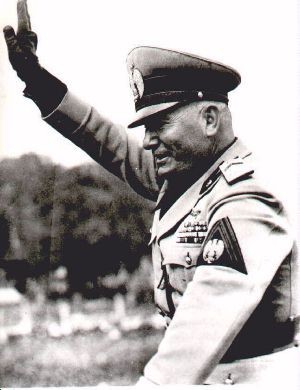
Knochen was told that Mussolini would discuss the matter personally with Ribbentrop on the 27 February 1943. Mussolini gave Ribbentrop an evasive answer. He agreed, nevertheless, that the military did not possess a correct understanding of the Jewish question. He attributed this in the first place to their “different intellectual formation.”
In short, Mussolini did not interfere with his generals. On 6 March 1943 Rothke recapitulated all the unfulfilled Italian assurances to Eichmann, adding that the Fourth Army had liberated two or three hundred more Jews, whom the French police had arrested at Annecy.
On 18 March 1943 d’Ajeta ordered the Italian legation staffs in Vichy and Paris to continue adopting a strong line about the French Prefects, but Marazzini, the liaison officer with the German High Command, informed Hagen of the Gestapo that the Jews in the Italian Zone, who had previously been under house arrest were now being interned.
This followed an interview between Mussolini and Mackensen, at which Mussolini had again apologised for “the silly sentimental ideas” of his generals. Ambrosio, the Chief of Staff, would see that they did not interfere again with the French police.
Four days later, Mackensen received one of those shocks from which a Nordic nature is not immune. Ambrosio had persuaded Mussolini that the French police were not to be trusted. The registration of the Jews in the Italian Zone would therefore be performed by Italian police, commanded by a certain Lospinoso, formerly chief of police for Bari, although the French police would still be allowed to handle the actual deportations.
Mackensen expressed his fear to Bastianini the Italian generals would continue to hamper the French police but Bastianini replied that Ambrosio’s orders to Vercellin were positive and immutable.
This last manoeuvre so electrified Himmler that he sent the highly recondite grand inquisitor of the Gestapo, Heinrich Muller, who scarcely ever left the Prinz Albrecht Strasse, on a visit to Rome.
On 27 March 1943 Muller learnt that Lospinoso had left for the Occupation Zone some days ago, but Knochen’s inquiries in Mentone were fruitless.
On 6 April 1943 Knochen was in such a state of nerves that he telegraphed Eichmann and Schellenberg of the SS Intelligence Services. He had learned from the Gestapo in Marseilles that Jews were simply pouring into the Italian Zone. The movement was apparently financed by one Donati, director of the Bank France- Italie. As to Lospinoso, he kept appearing and disappearing and Muller demanded magisterially that he be brought to Berlin.
But Lospinoso was not located till 26 May 1943, when Rothke learnt from the Gestapo in Marseilles that Lospinoso was living in the Villa Surany at Cimiez – in the uniform of a general.
He was in charge of a “Commissariat for Jewish Affairs” and his adjutant was a half –Jew Donati. Lospinoso had indeed begun the expulsion of the Jews of Nice and the coastline. With the aid of Donati’s committee he had put them in hotels at Vence and Megeve, well within the Italian Zone. Rene Bousquet, still Vichy Minister of Police and still mighty officious, protested that the hotels were meant for evacuated children.
Lospinoso thereupon consented to see a representative from d’Arquier’s commissariat – and asked him whether he happened to be a Jew. On 10 July 1943 the Marseilles Gestapo reported to Rothke that Lospinoso had moved 22,000 Jews under these human conditions.
A thousand Jews of the poorest class were living “in the best hotels in Isere and Savoie.” Rothke himself believed that altogether 50,000 Jews were in the Italian Zone.
The game of twisting the Gestapo’s tail was bound to end. Already Mussolini had agreed to hand the Occupation Zone over to the Germans, retaining only Nice where the Gestapo would take over Lospinoso’s office. On 22 July 1943, Rothke learnt that Donati had left for Rome to intercede for the doomed Jews.
Then, on 25 July 1943, Mussolini was arrested and a new Italian Government was formed under Marshal Badoglio. On 19 August 1943 Lospinoso called on the Gestapo in Marseilles to say that, since the change of government, he no longer considered himself bound by the agreement to hand his Nice office over to them.
In spite of this reprieve, the forces working in favour of the Jews showed a lack of decision. The very liberal instructions of the new Italian Foreign Office were not published before 1 September, when it appeared that the Italian Jews were to be repatriated and the stateless Jews brought back to the Nice enclave.
In the meantime, Donati had been to the Vatican, where he sounded out Allied representatives with a view to shipping the stateless Jews to North Africa in Italian liners. Nothing had been concluded on 8 September, when Eisenhower announced the terms of the Italian armistice and the Germans, as a consequence marched into the Italian Zone.
The Gestapo had planned for this moment, Alois Brunner had gone to Marseilles – he was to direct a mass round up of Jews without making any distinctions, and they were to be shipped to Drancy from Marseilles and Lyons. At Drancy they could be sorted out since the Italians possessed no effective registration system.
But though the Germans did not enter Nice till 14 September 1943, the Badoglio Government’s well meaning plan to bring the Jews back from Megeve into this apparently hopeless death-trap had not progressed very far. Only 2000 had been moved and the rest were able to scatter among mountain villages.
Tragedy seemed about to overwhelm many thousands of Jews who had never left the large towns, but Rothke’s threat was largely a vain one. Brunner could not achieve a real mass round-up without the complete collaboration of the French police.
In Nice Ribiere’s successor, Chaigneau, destroyed such lists that the Italians had left behind, Brunner was reduced to finding what he could in street man-hunts. Eichmann who arrived in Nice soon after the German Army, was shocked at the smallness of the catch, but he perceived the explanation.
He learnt at a party that 15,000 Jews were hiding in the mountains of the Principality of Monaco, those five square miles. On 23 September the German Consul in Monaco was instructed by the Foreign Office to arrange for the Security Police to enter the Principality but the Consul could only find 1,000 Jews, all of them old residents.
Eichmann nevertheless insisted that there were 10,000 – 15,000 Jews – the matter was pursued at intervals. In July 1944 the Consul told von Thadden of the Foreign Office that, following Eichmann’s inquiries most of the thousand Jews had found their way to Switzerland, Spain or the Maquis.
There remained forty-five, all of them adequately protected- only a few had been surrendered to the Security Police and taken to Drancy.
The extent of the German failure may be judged from the following results – one of the lists found in Rothke’s office, shows that only three transports left Drancy for Auschwitz in the three months following the fateful 8 September 1943, when the whole edifice of Italian protection collapsed.
Throughout Rothke’s letter file from 72 Avenue Foch runs a refrain – if only Laval would revoke the naturalisation papers granted since 1933 or even 1927- we could run the trains every day and fill them.
On 21 July 1943 Rothke believed that the revocation of the post-1927 naturalisations would make 50,000 Jews immediately available. As to French-born they were only deportable if they were already under lock and key as hostages, Judeo- bolshevist, or delinquents against the countless new regulations.
Thus out of 52,000 Jews who had been deported, only 6,000 were French by nationality, while the Free Zone which had been occupied eight months had contributed only 13,000 to the quota.
Even when the protection of the Italians was withdrawn, very few Jews who possessed French citizenship fell into the Germans net. The French police refused to arrest them. When the SD attempted to organise street pressgangs, the French Jews found friends to hide them.
To go back seven months before the Italian debacle, transports from Drancy to Auschwitz had been resumed in February 1943, after the agreed winter pause, but with great difficulty.
The round-up of 11 February was composed according to Dr Wellers, of children and very old people, the only foreign Jews who could be found at their registered addresses. The next day Knochen reported to Muller that Bousquet would not let the French police assist in deporting 1,300 French Jews who had been arrested for failing to wear the Jewish badge. Bousquet had offered 1,300 stateless Jews in their place. “It goes without saying that both categories will be deported.”
Standartenfuhrer Helmuth Knochen, who had served under Professor Six in a bogus information service of the Gestapo on “scientific affairs”, was not unduly gifted with a sense of proportion. He told Muller that the Americans were offering France the Italian colonies – and The Rhine, and that Laval would certainly hand over more Jews if the Germans bid higher.
On 6 March Rothke wrote to Eichmann that he hoped during April to deport 8,000 to 10,000 Jews a week, but in fact no Jews were deported in April, though five trains had left in March.
Whilst most transports from France went to Auschwitz- Birkenau four went to the Lublin district. Transports Numbers 50 and 51, with 2001people,left the Gurs internment camp on 4 March and 6 March1943.
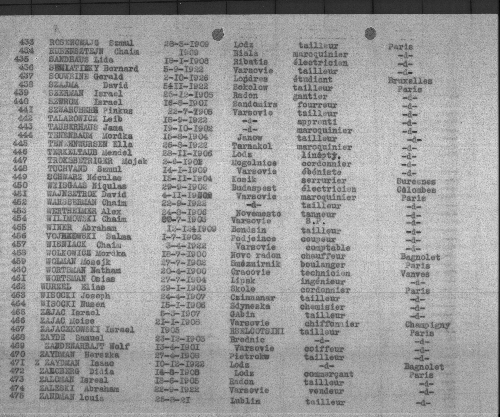
They reached Majdanek, where some were taken into the camp, the others were sent to the death camp at Sobibor and murdered there. Transport Number 52 with Jews from Marseille, left Drancy on 23 March 1943 for Sobibor and Transport Number 53 departed on 25 March 1943, Josef Dunitz was amongst those deported on Transport Number 53, he testified:
“I remember that we left Drancy on 25 March 1943. We travelled four days and arrived at Sobibor on 29/30 March 1943. We passed through Majdanek and the same day came to Sobibor – before we left Drancy, the Germans told us that we were going to Poland for work. They said we should take part in the war effort and not walk around the cities of France.
We were just being tricked. The transports that left Drancy were quite big, 1,000 people in each, fifty people in a freight car. We were a group of friends from Drancy, and in spite of the fact that we did not know what awaited us there, we wanted to escape.
We wanted to jump from the train when the other people in the car were sleeping, otherwise they would try to prevent the escape, as they were afraid of collective punishment. We made a hole in the floor – we started to jump, without knowing that in the last car were Gestapo with machine guns.
When the Germans understood that people were escaping, they started to shoot.- some were killed, I do not know how many of those who jumped succeeded in escaping. We reached Sobibor.
After we left the train, some SS men ordered that thirty people be selected for work. We did not know what was better, to be among the thirty taken for work or among those who were going in the other direction. Where were they going?
I saw that one of my friends from Drancy was among the thirty people taken to work. I joined this group. The Germans counted and found that we were thirty-one people. “Let there be thirty-one,” he said. In this way I remained in the group.”
Josef Dunitz and one other man Antonius Bardach, both of them from Transport Number 53, were the only survivors from the Jews deported from France to Sobibor. In June Rothke had to cancel a round-up and on 21 July 1943 Rothke reported that Heinrich von Stulpnagel refused absolutely to permit Wehrmacht units to assist in the deportations.
Just two years earlier, as the commander of the 17th Army in the Ukraine, Stulpnagel had signed an order that Jews and Communists should be shot in reprisal for all untraced acts of sabotage.
Such transformation from Saul to Paul were common during the German Army’s more rearward movements. Heinrich von Stulpnagel was to proceed further along that road.
On 20 July 1944, on the false report of Hitler’s assassination, he ordered the instant arrest of Oberg and Knochen. Summoned to report in Berlin, he attempted suicide while driving over the old battlefield of Verdun. With half his face blown off, he was tried by the People’s Court and duly strangled.
In the last year of the German occupation of France, Rothke could only achieve his round-ups of Jews through unreliable agents, the Darnand militia, the d’Arquier anti-Jewish police and the French “reporter service” of the Gestapo.
In July 1943 Alois Brunner the architect of the Vienna, Berlin and Salonika deportations, had tried to produce a sort of Jewish Ordnungsdienst. A number of Jews were allowed out of Drancy to collect friends and relatives by various appeals to sentiment or blackmail threats, but les missionnaires were not a success and they were withdrawn after a few weeks.
During these last twelve months, twenty Jewish deportation trains may have left France – it was largely a matter of clearing the camps and also the charitable institutions, conducted by UGIF under Gestapo licence.
Dr. Wellers states that in July 1944 the Paris orphanages and the Rothschild Home for the Aged were cleared. Rothke’s files contain the record of an earlier clearance. On 7 April 1944, Obersturmfuhrer Klaus Barbie of the Lyons Gestapo reported the dissolution of the Jewish Colonie des Enfants at Izieu, Ain. “Captured – forty-one children, aged from three years to ten, and ten attendants, the transport will leave for Drancy tomorrow.”
At Drancy there was a little trouble. “Dr von B said it was Rothke’s practice to make special provision for lodging such children. Sturmbannfuhrer Brunner said he knew nothing of such instructions and did not approve of them. He would act “according to the usual methods of deportation.”
Only two transports left for Auschwitz in April 1944 and one in May, yet on 14 April Knochen made a last despairing attempt at a general round-up, from which even half-Jews were not to be exempt.
Brunner was told to remove the Jews from all French camps and prisons to prevent the French authorities taking them elsewhere – an indication of the changed attitude of the French police.
This was the so-called “intellectuals” transport which arrived in Auschwitz from Drancy on 30 April 1944. Since practically all the victims possessed “criminal records,” that is to say an existence recorded in judicial proceedings of one kind or another, they could not be gassed on arrival.
On 12 May 1944, all but seventeen out of 1,655 Jews were transferred to Buchenwald concentration camp, in order to make room in Birkenau for the forthcoming Hungarian deportations.
The invasion of France was imminent, too, but this created grave dangers for the Jews of France. For instance, there was a period of a week between the Allied landings in the South of France and the fall of Paris, when the Gestapo centred on Lyons, ran amok.
Jews were picked up and murdered at random, sometimes in mass executions, but deportation was scarcely possible now that the French railways had been bombed almost to a standstill.
Thus the evacuation of Drancy, which had been intended for 13 August 1944, ten days before the liberation of Paris, had to be cancelled and 700 Jews remained in the camp when the Allies arrived.
Dr Wellers who had access to the Drancy registration lists, estimates that in the last phase of the deportations between June 1943 and August 1944, only 17,000 Jews left France.
If this number is added to the earlier figures recorded by the Gestapo, a total is reached which is less than 65,000 and of these 2,800 are known to have returned from Germany.
It is impossible to estimate the total number of Jews with whom the Gestapo had to deal and of which they themselves were extremely ignorant, but allowing for escapes, it was still probably not much less than 300,000.
With a loss barely exceeding 20 per cent, no Jewish community in Europe came off so lightly, except in Italy and Denmark, and this was due in large measure to the tactics of Laval, a man who was shot by his compatriots for treason.
But it is wrong to ascribe the survival of three quarters of the Jews in France to the cleverness of any individual. The Final Solution, which was applied so successfully in Central and Eastern Europe, failed in France because of the sense of decency in the common man who, having suffered the utmost depths of self-humiliation learnt to conquer fear.
Sources:
The Final Solution by G. Reitlinger – Vallentine Mitchell &Co Ltd 1953. Auschwitz Chronicle by Danuta Czech published by Henry Holt New York 1989. Belzec, Sobibor Treblinka by Yitzhak Arad, published by Indiana University Press, Bloomington and Indianapolis 1987. Encyclopedia of the Holocaust – published by MacMillan Publishing Company New York 1990. Bundesarchive Koblenz
Copyright Chris Webb H.E.A.R.T 2007 | ||||||||||