Holocaust Education & Archive Research Team |
|
Survivor Stories
Holocaust Survivors Chelmno Survivors Righteous Gentiles Holocaust Recalled
| ||||||||||
The Family Brichta Part Two – Prague and Deportation to Theresienstadt
Prague
My mother’s and my arrival in Prague
The next few days and weeks were confusing, so many events, so many bad news in quick succession, no fixed abode, the past certainties such as home, school, town, friends, relatives, everything I knew abruptly broken. We had turned into refugees, like so many there, in a strange country with a strange language. Czech is Slavonic and has no connection whatever with German or with any Romance language.
From the State Central Archives in Prague I now have a copy of our police register, (App. ) In Austria and Czechoslovakia, which had been part of the Austrian Empire until October 1918, every move by a citizen had to be registered with the police and such documents are now useful. The first part of the form contains every possible detail, including the names of the father’s parents and grandparents, our names, my mother’s maiden name, when and where we were born, religion, marital state, profession, domicile, day, month and year of marriage.
No identity card could be that comprehensive. The second part contains the changes of address, the day, month, year of the move from, the place moved to, the name of the street, the number, the landlord and the date of leaving the premises. They certainly kept their tabs on one and that was certainly a liberal democracy, not a totalitarian state.
The Library
On arrival in Prague my mother and I stayed at a cheap hotel, called a pension (pronounced the French way) run by nuns. Accordingly it was Spartan to say the least. Until my father joined us and found something permanent, although permanent is perhaps the wrong word in those uncertain times, that’s where we stayed. It was not far from Prague’s main thoroughfare, the St. Wenceslaus Square (Václavské náměsti) with the equestrian statue of good King Wenceslaus (Václav I, r.900-929, who was murdered in the St.Vitus cathedral in circumstances similar to the murder of Thomas á Becket, Archbishop of Canterbury, in Canterbury Cathedral, in 1170 in the reign of Henry II, both became national saints and places of pilgrimage).
St Wenceslaus Square is a sloping very wide street and is short in proportion to its width. Tramlines run along its centre. At the top end is the National Museum. At the bottom was, and may be is again, the Street of the 28 October, commemorating the day the Republic was declared in 1918. The Germans did not surrender on the Western Front until November 11th. The Austrian Empire had collapsed two weeks before the German one.
Also at the top end was a small lending library with German books. It became a second home, I read something like a book a day. Karl Mai's Wild West stories about Red Indians and Cowboys, all written in Germany, and translations into German of Zane Grey’s novels, also of that genre, but also popular science, like “Die Mikrobenjäger” (the Microbe Hunters) by Paul de Kruif, about the pioneers in micro-biology, like Koch and Pasteur, who taught themselves to dye microbes to be able to study them under the microscope, who created antibodies and discovered the ways of inoculation against diseases like diptheria, typhus, smallpox, cholera, anthrax in sheep and humans which had killed millions until they had come along.
Others found the causes and the cycle in the blood stream and the transmitter of malaria, the anopheles mosquito, all taking years of patience and trials on animals and risks to themselves in a new field. Also inspiring was the quest to find a cure for syphilis where the winners were Paul Ehrlich and the Japanese Hata who won the Nobel Prize jointly in 1906 for Salvarsan manufactured by the German pharmaceutical company Bayer, also known as Product 606 because it was the 606th attempt at an arsenic based substance which was successful.
Paul Ehrlich was Jewish but the Germans claimed him as their own and, at the time, he thought of himself as being German. My mother claimed that she was related to the Ehrlichs. The book impressed me so much that I remember most details and, on the strength of it, I decided to become a micro-biologist. However fate got in the way and decreed otherwise.
This existence in no-men’s-land, shared with other refugees worse off than the two of us, lasted for six months. From the police register I know that we didn’t move into our small flat until 29 November 1938 and we were going to live there for the next 4½ years.
My Father’s Whereabouts
So where was my father meantime? I now have a personal note and a formal reference from Dr.Walter Pincus, the owner of the Jewish bank where my father had been company secretary, etc for 15 years, dated 1 August 1938, i.e. his job did not officially come to an end until then, by which time we were out of harm’s way in Prague.
By “out of harm’s way” I mean Kristallnacht when synagogues were burned to the ground, hundreds of people were arrested and sent to concentration camps and a fine of a milliard Deutschmarks imposed on the Jewish population (never repaid after the war) and the insurance money pocketed by the state, which took place on 9 November 1938, a date which seems to hold a fascination for terrorists and others of that ilk.
I know that my father travelled to and from Berlin to continue with periodontic treatment by his Berlin dentist. His years in Russian captivity lead to paradentose, or receding gums, caused by lack of vitamin C, the same illness suffered by sailors on long voyages, until it was discovered that limes, similar to lemons, prevented it. His dental treatment consisted of every tooth being drilled at a slightly different angle, tight-fitting pins being passed through and the pins connected to a metal band behind the teeth.
All that naturally took time but then, as a foreigner, he was free to travel but it left us two in a limbo. He also joined up. During the Sudeten and Munich crises the Czechs had a short mobilisation. On May 20, 1938 Czechoslovak reservists were recalled, but it could have been from 23 to 30 September 1938 if one looks at the rapidly unfolding events.
The Munich Crisis
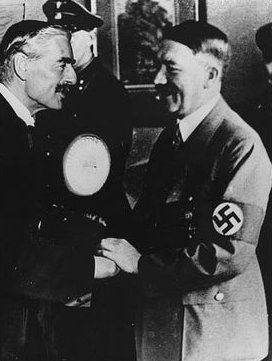
The Munich Crisis, as it became known, came about at the end of September 1938 on Hitler’s terms and was concerned with Germany’s designs on Czechoslovakia, with France, her ally, showing no interest in protecting her. In fact the Czechoslovak government was excluded from the talks concerning the very fate “of a faraway country about which we know nothing” and her defences within the Sudetenland were not on Mr. Neville Chamberlain’s agenda either. The Czechs felt to have been, and were, abandoned and, as an act of defiance and a gesture that they would fight alone, mobilised.
By 30 September 1938 Chamberlain had accepted Hitler’s ultimatum, the very same which he had rejected on 23 September. He then gave an Allied guarantee of a rump Czechoslovakian state which was as useless as the piece of paper he waved on arrival back in London and his words “Peace in our time” which he must have come to regret.
I know that my father enjoyed his short spell at soldiering but at a most bewildering time for all refugees in Prague, and that was where thousands of them were, whose fate hung in the balance on the outcome of these talks and with every news being bad news we could have done with him.
My Father’s Arrival in Prague
Even after he had been demobilised he was out and about and that, as it turned out, was fortunate. May be not as fortunate as trying to emigrate, something I don’t think my parents contemplated at that time, but fortunate if we were going to stay. He liked people and in a way he was unique in the circumstances then prevailing. He was, as it were, an honorary Berliner who knew of their plight, but he was also a native who spoke Czech.
Certainly once he had arranged to rent one of the many small apartments in the district of Líbeň, a developments of six storey blocks of flats at na kopečku (on the hillock), and what remained of our furniture had arrived from storage and we had moved in on, as already mentioned, 29 November 1938, he made use of his contacts and volunteered to work for nothing for the Jewish community.
This community organisation barely existed, there had been very little need for it. There were some poor people who needed assistance, there was a school with hardly any pupils as I found out, and possibly an orphanage and an old people’s home. Contributions, or a tax on the better off, introduced by the Austrians, made this arrangement tick over with the minimum of employees. They were thus completely unprepared for the influx of refugees, first from Germany, then the flood from Austria and then the deluge from the Sudeten.
For a short period their task was humanitarian aid, accommodation, food, pocket money and organising training in various trades for those hoping to be able to emigrate and needing, or perceiving to be needing, handicraft rather than professional skills. It was a somewhat hopeless task. The refugees had besieged, and to no avail, foreign embassies and consulates in the towns where they had come from. They continued with the same zeal bordering on desperation, this daily routine in Prague and with the same result, and now they had to compete for the fixed number of available visas with the local Czech Jews.
The Community, later known as the Ältestenrat (Council of Elders)
The community, such as it was towards the end of 1938, welcomed my father with open arms. He spoke both languages fluently, was a very good administrator and cost no money. Immediately following the occupation on 15 March 1939 all the anti-Jewish laws which had been promulgated in Germany since 1933, such as the dismissal of Jewish public employees, school teachers, university professors and lecturers, army personnel, the expropriation of Jewish shops and enterprises, the prohibition of Jewish doctors and dentists to attend non-Jewish patients and a drastic reduction in the number permitted to practice at all, the declaration of accounts, of property, the handing in of gold, silver and valuables, of cars, musical instruments, bicycles, sewing machines, cameras, skiing outfits, surgery equipment, etc. required more community employees to implement these laws, rules and restrictions.
When deportations started in October 1941 from Prague to Lodž in Poland and from Brno in Moravia to Minsk in Russia and then, from November 1941, when Jews from all over the Protektorat were sent first to the ghetto of Theresienstadt before being sent on to the East from there, to the end of July 1943, when Bohemia and Moravia had been made Judenrein, cleansed of Jews, the number of employees had grown very large.
Many had to deal with the 16-page property declaration every deportee had to fill in before handing in his or her keys of flat or house at the point of departure which then formed the basis of well organised looting, storing, sorting, valuing, separation and dividing into groups, i.e. books, kitchen utensils, carpets, furniture, clothing, pictures, etc. The Germans were very keen to know beforehand what was to fall into their grubby hands. Once all Jews had been deported the jobs of the employees had come to an end and they themselves were sent to the ghetto and onwards from there.
However, and obviously, the longer one was able to stay behind and out of the transit ghetto, the greater the chances of survival since, as soon as one arrived in the ghetto, one became eligible for such onward transport, see the fate of my two good friends Kurt Herschmann and Kurt Diamant.
Thus, as my father was head of the section dealing with these property declarations (Vermőgenserklärungen), our deportation was postponed until 13 July 1943. This late departure gave us the chance, too small as it turned out for my parents, to survive.
The summer of 1938
What I remember of the summer of 1938 in Prague is that it was very hot with refugees milling about the centre of town and that we tried to creep into the shade. Prague is in a hollow and traps heat. It is also humid, a wide river, the Vltava, or Moldau, flowing through it and its medieval builders knew very well how to deal with that, they built arched and vaulted walkways in front of shops and around squares.
I cannot remember when exactly I started to attend school but it was probably shortly after we had moved into our flat in Líbeň at the end of November 1938 by which time snow and ice covered the streets. To learn Czech was of the utmost importance and my father found a Jewish high school student who came to our flat once a week to teach me.
As this young man spoke no German whatsoever conversation proved fraught at first but the Czech book of grammar with its rules and exceptions, genders and cases, seven of the latter, and a dictionary, soon got me going and before long I was fluent with a large vocabulary.
After all, I had nothing else to do and one was surrounded by the sound which helped. At my age, I had just turned ten, one absorbs quickly and tram drivers mistook me for a native. My mother never learned Czech, had no need for it and because, with the exception of a handful of occasions when we visited relatives from my father’s side, who disappeared early on, she never left the flat throughout the 4½ years we lived there, not much of an existence.
With restrictions implemented soon afterwards there was nowhere to go anyway. Any shopping to the greengrocer at the corner of the street had to be done by me in Czech. In any case I was less conspicuous when it was done out of the restricted Jewish shopping hour, and I ventured to the pub at the corner opposite the greengrocer, using the rear entrance and through the kitchen to get a jug of beer, again, because I was 12 to 14, in short trousers and didn’t attract attention to my illegal activity.
My School in Prague before the German Invasion
My father had enrolled me at the Jewish school. It was nominally a religious (náboženská) school and it was located in the Old Town on the Jáchymova street. In Berlin my school had been on the Joachimstaler Strasse. Jáchymov is the Czech for Joachimstal, which is a coincidence.
It is there that radioactive pitchblende is found from which Madame Curie extracted gamma rays, but that is by the way. When I started there the differences between it and my Berlin primary school were most noticeable. The Prague school had no assembly hall, no gym, no laboratory, not a single scientific instrument, Bunsen burner or microscope, no school yard, and the Berlin one had been small enough.
It had long old-fashioned benches and no pupils. I could have been enrolled at any of the Czech schools but at that time could not yet speak Czech. There were also German schools, there was a German Charles University in Prague, but teachers and pupils there were ardent Nazis. To the charge that the Jewish school didn’t offer a liberal education the answer is that it had never been the intention of its founders, rightly or wrongly, to provide that. On the other hand it didn’t provide a religious education either.
I was very keen to continue learning Hebrew and to build on what I had been taught in Berlin and to read the prophets and psalms in the original, as I did later, to a small extent, for my barmitzvah, but we weren’t taught that either. I attended the school from the end of 1938 to June 1942, when the school was closed, and I can honestly say that I have no secondary education.
Subjects like physics, chemistry, mathematics, pure and applied, biology, history, economics, ancient or modern language all remained a closed secret except for the popular science books which I bought with my pocket money and read by myself. More about that later.
Na kopečku, č.p.1915, our block of flats
Let me explain right from the start that č.p. means číslo popisné or description or registration number. Houses there have two numbers, the street number and the land registry number. As it wasn’t really a street yet it had only the land registry number.
This block of small flats, or apartments, my father had found for us and into which we moved on 29 November 1938 (see p. ) had only just been completed. It had been designed and built and was made ready by a Czech architect, they were more versatile that their British counterparts.
I remember being taken to his office and admiring his drawing instruments displayed in a large glass case. The development, as it would now be called, was on a large scale, there were three adjoining identical blocks six storeys high, the upper two had balconies. I know about only one of them, the outer block in which we lived on the fifth floor.
A reinforced concrete framed structure it was clad in matt, light-coloured tiles which kept it clean to this day. Along the ground floor the outside of the building is now disfigured by graffiti, at least we didn’t have them in those days over 60 years ago. It had a basement where each tenant had a compartment or storage space which in reality was only a wire-mesh fence stapled to a wooden frame and, because it was so open things got stolen. E.g. we had a bronze chandelier from Berlin which we couldn’t accommodate upstairs, one day it had gone.
But since everything was to go or had already gone that didn’t matter any more. The basement also housed the central heating boilers and coal store and the porter’s flat. There was a telephone in the entrance lobby just behind the entrance door and that was very handy indeed as Jews were not allowed to have phones except for a few doctors, only those who were permitted to practice, though only have Jewish patients.
That facility was to save my life. There was a lift, though I preferred to run up and down the stairs taking two steps at a time.
Na kopečku, - Its Jewish tenants
Because the block had been completed at the time of the Munich crisis it is not surprising that a few families from the Sudeten had landed there as the Munich crisis developed, the local Nazis became more confident and threatening and the prospect that Jews would share the fate of their German and Austrian brethren more certain.
The Fantls lived on the sixth floor, the floor above above us. There was Dr.Leo Fantl and his wife, Dr.Helene Fantl, both philologists, and their two children, Brigitte and Friedrich, or Bedřich in Czech. What I knew of Dr.Leo at the time was that he had a great interest in graphology which he shared with Dr.Gottfried (Friedl) Bloch on the ground floor, and that he was also a cantor (chazan).
On one of the High Days, on Yom Kippur, the day of Atonement, in 1940 and 1941 my father asked me to go to the synagogue where Dr.Fantl officiated single-handedly all day to make up numbers, the community had already shrunk considerably under the impact of deportations and were also afraid to attend.
As I could read Hebrew I could follow the service, his voice was very clear. He too worked for the Jewish Community and from the list of its employees in 1942, now in my possession, I now know that he was a “Matrikenfűhrer”, which I translate as the manager of the index-card department. According to Dr.Gottfried Bloch’s book “Unfree Associations” Dr.Leo Fantl had been a well known music critic for a Dresden newspaper.
This was confirmed by Mrs. Helen Gregory who searched the internet for me. However I always spoke to members of the family in Czech and had then no idea that they had lived or that their children had been born in Germany.
All I knew is that they had fled to Prague from Teplitz/ Teplice in the Sudeten. Therefore my guess is that they had originated in Teplitz in the Czechoslovak Republic and had, just like my father, found work in Germany after the Great War, had returned to the Republic and their home town after the Nazi takeover when he would have lost his post around 1933/35 and that the children had learned Czech in Teplitz at an early age. A few years ago I found that Dr. Leo Fantl had been born in Prague.
On the fifth floor, next door to us on one side lived a single Czech man and on the other side lived a Jewish mother and daughter. We believed that the Czech man kept listening to the BBC’s broadcast in Czech from London, an offence punishable by death, and my father tried to listen in by means of a listening device consisting of a saucepan with the open end pressed against the wall acting as an amplifier, but to no avail.
Our neighbour had the radio on so softly that only he could just about hear it. With Jews being forbidden to buy or read newspaper we were all desperate for reliable news of the progress of the war, our only hope. What Jews passed on as news among themselves, called bonkes, many may have been reliable at the start but, after having been passed around, were embellished in the process and were either too good to be true or so bad that one didn’t want to believe them.
The Jewish mother and daughter had also fled from the Sudeten. The husband/father had been an officer in the Czechoslovak army and had died. Life expectancy was much lower then than it is now. As was the custom among officers, one of them would look after the widow and her children and one of them did, he was not Jewish. When the two were due to be deported on one of the first transports to the ghetto of Lodž/Litzmannstadt towards the end of October 1941, he volunteered to go with them and, although not Jewish himself, was permitted to do so.
It was most gallant and chivalrous but he could have done nothing for them there. Of the 5,000 men, women, children and old people sent to that ghetto 276 survived. One of them was my friend and fellow prisoner in Friedland, Paul Briess/Brennan but than he had a marketable skill, he had learned electric arc welding and German industry needed that, or at least until that ghetto was liquidated by the inhabitants being sent to Auschwitz.
On the floor below us lived two families from Teplitz, a teacher and his German-Aryan wife, i.e. a mixed marriage which protected the Jewish husband from deportation. Although he had only been a high school teacher he was called professor, now with time on his hands. I was attending school for half a day only and I had no homework so I too had time on my hands.
He asked me whether he could teach me algebra and German shorthand. I never took to German shorthand but I lapped up algebra, a facility which five years later came useful when I started to attend London’s Regent Street Polytechnic’s evening classes in mechanical engineering from September 1946 onwards.
The other family on the floor below us consisted of a mother with her two adult sons. She was getting on. Mother was elderly, the older of the two men, they were hardly boys, had been a prisoner of war in Siberia, just like my father had been.
He had remained single. The younger one was sent by the Germans to Theresienstadt to turn this ancient fortress town, built at the end of the 18th century by Emperor Joseph II of Habsburg and named after his mother, the Empress Maria Therese, into a transition camp for onward deportation to the east, i.e into a staging post.
The number of inmates it was to hold was to be ten times that of its pre-war population. These construction workers were treated like concentration camp prisoners and communication with the outside world was strictly forbidden. They were not, however, behind barbed wire, there was no need for it. Just as the town had been designed as a fortress which prevented anybody entering except through two huge and easily guarded gates, so nobody from the inside could get out either.
This younger brother had a girlfriend and tried to send her a letter. The letter was intercepted and he was condemned to be hanged. He wasn’t the only one. Hanging, in public and in secret was practiced widely by the German army and the SS all over occupied Europe and particularly in Poland and in Russia.
The rumour we received was that the rope broke and that an SA man stepped forward and shot him dead with a pistol. I remember the adults in our block of flats being upset because, so they said, under international law once the rope had snapped the prisoner had to be freed.
But then under any real system of law, except the German one, a citizen would not have been deprived of liberty, turned into a slave labourer and condemned to death without due process simply on account of his race and for sending a letter in the first place.
It just showed that one still clung to civilised ideas during an uncivilised and barbarous era. The Germans seemed to have found the change from civilised to barbarous behaviour much easier.
The older brother was caught visiting a prostitute, a part of the Old Town was a red light district. That was strictly illegal according to the Laws of Nuremberg (Nűrnberger Gesetze) of 1935 because it was a sexual act between a Jew and an Aryan although the woman was not a true Aryan as she was a Czech, therefore a Slav and therefore, by definition, of an inferior race, though not as low in the grading system as a Jew.
For the purpose of the prosecution it was however an offence. He was sentenced by a properly constituted court, if any such court can be considered properly constituted, to three years’ imprisonment. In such cases the longer the sentence the better because prison was definitely preferable to a concentration camp.
On the other hand such prisoners were never released. After serving their sentence they were sent to Auschwitz or to a similar establishment like Sachsenhausen, Buchenwald, etc. Many were sent to Auschwitz long before the completion of their sentence, see “Inherit the Truth” by Anita Lasker-Wallfisch, cellist and survivor of Auschwitz and Belsen, Giles de la Mare Publishers Ltd., 1998. Anita and her sister were sentenced to a prison term for trying to flee from Breslau to France. After a few months into their sentence they were sent to Auschwitz.
Downstairs, at ground floor level, next to the entrance, lived the Blochs, father Max, mother Herta and son Gottfried or Friedl. Friedl had been a medical student at the German Charles University of Prague and would have sat for his finals if the Nazis, who ran the university long before the Munich crisis, had not prevented it.
Friedl was very interested in and studied graphology and what would now be called industrial psychology. He worked for a time for the Jewish community offices trying to fit people to courses in various trades, something prospective emigrants hoped would help them to secure a visa and enable them to earn a living abroad.
For that purpose he conducted psychotechnical tests and I remember that I too took part in one, that I squeezed a hollow rubber ball connected via a rubber tube to a pen moving along a piece of paper, indicating whether I let go gradually or suddenly, that I put a mechanical toy together and had the time I needed for completion measured and that I deciphered colour-shaded numbers or letters hidden among similar looking coloured shapes, the Rohrschach test.
Father Bloch, an accountant by profession, became a spectacle maker and repairer. In summer mother Herta would come to sit on our balcony to soak up the sun and read English detective novels. Their ground floor flat got very little light. They were sent to the ghetto on 6 March 1943, four months before us. Their flat was emptied, its contents put into a removal van to be sorted locally and distributed in Germany.
I suppose that party members kept the best bits. And their descendants still do. A German woman and child moved in. Possibly she had been bombed out in Germany, we knew nothing about her, she was the only German in the building. It was all part of their plan to make use of everything Jewish, including, of course, their homes. This would be less obvious in Prague which was never bombed and had only a small German population. The Blochs were sent from the ghetto to Auschwitz, to the notorious “family camp”, on 18 December 1943, or five months after we arrived though I never bumped into any of them.
It was a crowded place and I moved only between room and work and my mother’s large room which she shared with what seemed hundreds of other women in one of the 200 years old barracks. Friedl survived and wrote a book of his experiences. His parents were gassed in July 1944 with the rest of those considered too old for heavy work.
The Meeting Place
For something like four years our small flat was the meeting place for Dr.Leo Fantl from upstairs, Friedl Bloch from the ground floor and, until he was imprisoned, the older brother from the floor below us, the name of whom I have forgotten.
My father was a very gregarious and generous man and through his connections and the money he still had and the items he sold, he bought things on the black market, including tobacco from which I made cigarettes.
Lives of other refugees
Above I mentioned the Jewish inhabitants of our block of flats. All of them had come from the Sudeten, except for us, and because they were Czech citizens and some of them spoke Czech and had some savings in Czech currency or, in the case of the teacher, were in receipt of a pension, they were all, relatively speaking, much better off than the thousands who had come as refugees from Germany and Austria who had nothing.
I would like to remember two such adult refugees I met for a short while. One was an actor and I think he had come from Vienna. The Austrians, now incorporated in the Reich and very happy to be once again part of a large empire, had deprived him of his livelihood, he could not appear in public and he had fled to Prague just across the border.
What can a middle-aged German actor do in a Czech-speaking city? Not much. I have a speech defect, sometime I get into a spasm when trying to pronounce a word which starts with a consonant. My father thought that learning to breathe properly might help. Actors learn how to breathe properly so as not to run out of breath when delivering a long soliloquy. So I went to see him a few times in his room where he lodged.
He was surrounded by photographs of his days on the stage and of those who had been household names and who, so he claimed, had trodden the boards with him. Real or not, and the stage is a world of make-believe, this past which saw his name on billboards, however small the type, was very important to him.
There was no present. As things stood there was no future for him. All he had was the past to reassure him of his worth. And there were thousands like him. The other refugee had been a chief steward on a German passenger ship when long voyages were all made by ship. Though I am not 100% sure of the name of the ship it could have been the S.S. Bremen which rings a slight bell.
Again, what could a German-speaking ship’s steward do in Czech-speaking landlocked Prague? Very little. He came to see us to demonstrate his skills for a small fee. His skill and experience had been in organising a team of German waiters on a large floating restaurant between German and American ports, which wasn’t much use in the present situation.
What he did do was to show us how to lay a dinner table properly. As we still had a few plates and knives, forks and spoons of various sizes we supplied the tools of the trade, as it were. He then performed his show-stopper, pulling away the tablecloth without upsetting anything, particularly the glasses. Quite unreal in the circumstances, but what else could he do? Both of them faded from the scene never to be heard of again.
The Initial Progress of the War
Blows came in rapid succession. The performance of the German Army and Air Force probably exceeded their own expectation and caused deep despondency in us. The Germans had swept through Poland in less than five weeks (01.09.1939 to 04.10.1939) until they had reached the line agreed with the Soviets by the secret Ribbentrop-Molotov Pact of 23 August of that year.
They then walked through Holland and Belgium (10.05.1940 -28.05.1940) and had defeated France in record time (14.05.1940 - 22.06.1940). Their progress along that front had been phenomenal.
From the bombing of Rotterdam on 10 May 1939, showing what barbarism Germany was capable of, to the fall of Holland, it had taken them just 18 days. From the crossing of the French frontier with Belgium on 14 May 1940 to the fall of Paris on 16 June 1940, the defeat of France took less than five weeks, less than it had taken Germany and Russia to knock out Poland.
A Russia siding with Nazi Germany was very frightening indeed. Then there was a lull in further expansion though that was a preparation for such an expansion, namely what was to become known as the Battle of Britain. May be the Battle of Britain was not a lull, but it thwarted Germany’s immediate ambition to invade Great Britain but not necessarily for ever.
Starting on 9 April 1940, by October that battle in the sky was over but news were no better on another front and Germany’s triumphant announcements of British commercial tonnage sunk by her large fleet of U-boats and of British battleships sunk by Germany’s “pocket battleships” made us despair.
Time was not on our side. I remember my father bringing home a very large and detailed map of France. That would be just before the end of the “phoney war”. During the evening meetings they were going to follow the progress as the two armies were going to slog it out, a repeat of 1914-1918. Hardly had the map been spread out before it was put away again. Neutral countries, like Switzerland and Sweden, supplied Germany with high-grade steel, ball bearings and raw materials for cash, for gold looted from Jews as it turned out later.
The prizes of German victories were France’s coal, Czech grain, Škoda’s tanks and guns, Polish and Ukrainian cheap forced labour, all for the asking. No fewer than 2 million French soldiers were interned for work in Germany, as were the remnants of the Polish army which I met in Friedland. In peacetime a week, a month, or even a year here or there may not matter, to us every day mattered. The news from North Africa, Romania, Yugoslavia, Greece, Crete, etc. was no better.
Making Cigarettes
My job was to make the ration of cigarettes for the evening meetings. The tobacco came in small, square packages, something like an inch thick and four by four inches wide. It was of course Balkan Tobacco and came from Bosnia-Hercegovina. I put it into an old mahogany cigar box, spread it out flat, covered it with blotting paper cut to the exact size, put thin slices of potato on the blotting paper and shut the lid. That gave it the right amount of moisture.
I was supplied with empty, preformed cigarette paper tubes with a filter tip and a pusher consisting of a thin metal rod with a wooden handle at one end and a widened metal part, similar to the head of a nail, at the other.
The other essential tool was a split metal tube hinged along its entire length. The tube was opened, tobacco was spread uniformly along its length equal to just over the length of the cigarette, it was clicked shut, inserted into the end of the paper tube and the pusher used to transfer the tobacco from the metal tube into the paper tube.
The now empty metal tube was withdrawn and the pusher used to give the end of the cigarette a flat finish. On the day that the visitors were due I would prepare a given number of cigarettes. I never saw them smoke though. Ours was a one-bedroom flat. My parents slept in the one bedroom and I slept in the living room. My bedtime was 8:00pm sharp and I got into my parents' bed for my first round of sleep.
The visitors came and went - the window was open to air the room. I would get up and help turn the settee over. The settee was a German patented affair on which my uncle Fritz had slept as a young man after he had left the orphanage and had moved in with his mother. It was a settee on one horizontal side with a bed underneath. One would lift the settee part, first one end which would click into the raised position then do the same with the other end.
If two were doing it simultaneously the settee would be raised in one go and turned quite easily through 180 degrees about the hinge, one on either side, which came into play in the raised position. One would then get hold of two handles, step on a lever at floor level, that would disengage the mechanism which had kept it in the elevated position, and one would let it down.
It was now a bed if one raised the hinged metal headrests, one at either end, which had held the bedding in place in the upside down position. All very ingenious. I then got into this, my own, bed and carried on sleeping. The interruption did me no harm at all.
The Day the Germans Arrived
I estimate that we lived about 3 miles from the edge of the Old Town in the centre of which the school was situated. There were trams in the old town but they didn’t take me home. Rather than change trams it was easier to walk through the narrow streets to the edge of the Old Town and take a tram from there.
Where I emerged from the Old Town was the námĕsti republiky, the Square of the Republic from where I could see the Prašná Brána, the Powder Tower, a very tall, massive, turreted, medieval stone tower with arches at ground level so tall that traffic passes nowadays through them, where gunpowder had been stored during the wars with Gustav Adolph of Sweden (1632?).
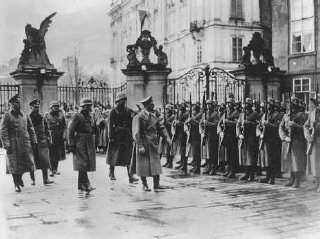
Before the war an ancient standard hung from the wall of the Alt-Neu ancient synagogue in Prague, given to the Jews for helping to defend the town. It must have been early afternoon of 15 March 1939 that I emerged from the Old Town on my way home. It was snowing hard, large flakes tumbling down reducing visibility, I could just about make out the Powder Tower. The sight I beheld has never left me. It was of German troops on motorcycles with sidecars, the sidecars had a light machinegun mounted on the front.
There were also large military trucks towing a trailer of equally large size. The trucks and trailers were empty and many more arrived during the next few days. These were the mechanical equivalent of locusts and meant for looting. The Republic had emerged from the depression. Czechoslovakia was in all respects self-sufficient, the Czech parts was industrial with a highly skilled workforce and also agriculture, Slovakia was just agriculture. Food was excellent and plentiful, clothing material, shoes, etc. were all locally manufactured and of very good quality.
In Germany, on the other hand, food was scarce, they preferred guns to butter and the guns were to reap other people’s butter. In Germany “Ersatz” (substitute) was the order of the day and has even crept into English. After the trucks had come and gone there was nothing left. The German Fifth Column had once again done its work, the German army knew exactly where to go. German soldiers fingered the cloth of Czech uniforms with astonishment, it compared rather favourably with their own.
I remembered German troops only too well from my recent Berlin days. To see them after we had hoped, rather optimistically, to have left them behind for good, hit me hard. We had, after all, not escaped and we would now not be in the position of protected foreigners. We were trapped. The Czechs around me were in tears. Their world too had collapsed though not to the same extent as ours. They had been handed over to the tender mercies of fascists by the so-called “free world” on which they had relied, with which they had identified and had signed treaties of protection with.
That shock had a lasting effect and helped the Communists to win the first election after the war and, once in power, they couldn’t get rid of them for another 42 years.
My School after the German Invasion
The German occupation caused the once empty school to be filled to the brim. Jewish children were now forbidden to attend even Czech schools, never mind German ones, and many of them, not all, came over to the Jewish one which had to work in two shifts, either one attended during the morning or in the afternoon.
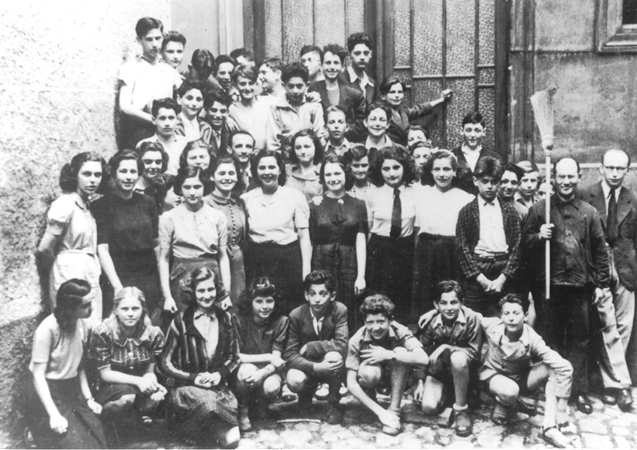
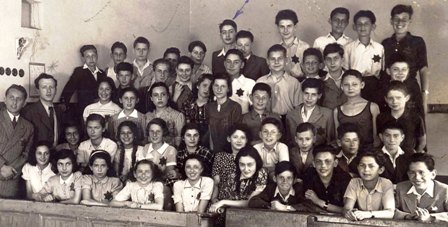
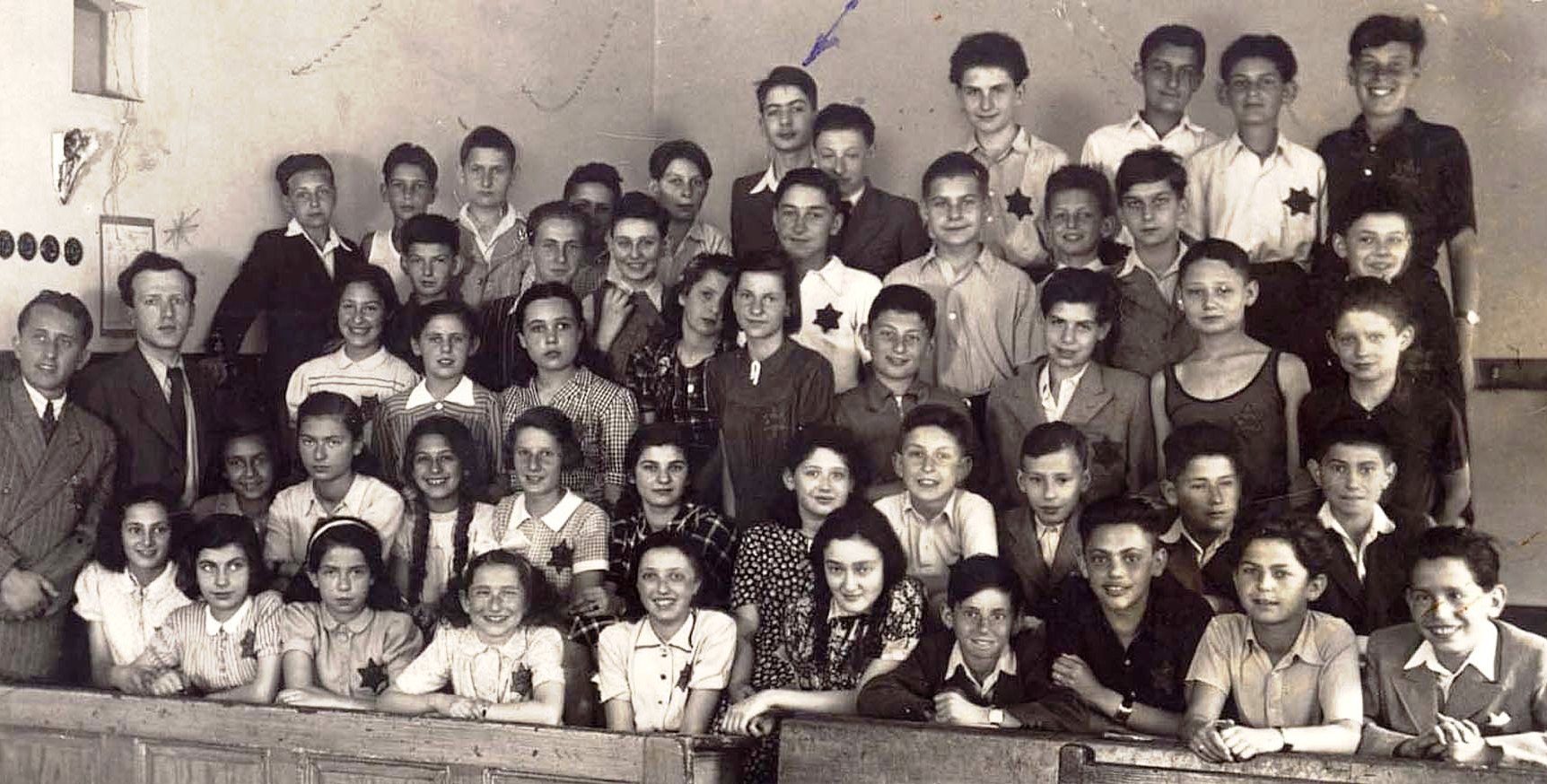
Even so classes were large. My class photo shows 49 children and a few had already been deported before the photo was taken. The school also took on new teachers who, just as they had done in Berlin and all over Germany, had lost their posts in the public sector.
Quite apart from the inherent lack of facilities it is most likely that the German occupiers dictated the content of the syllabus and it was not their intention to educate Jews who were to be used only as cheap labour on heavy work anyway or, the only other alternative, were to be killed as indeed they were.
So what did we do at school? I remember doing German, that was of course compulsory, but I knew it anyway and so did allof the refugee children who made up a large part of the class, and school.
We also did Czech grammar which by then I knew too, we did Czech literature but at a very low level, and the geography of Bohemia and Moravia, i.e. its rivers, and as we were confined to Prague and couldn’t go on excursions to give this geography some meaning that was pretty boring.
We had hardly any homework, with the very large classes and a class in the morning and a different one in the afternoon the teachers could not have coped. We did not learn Hebrew and we did not go through the Old Testament in translation even though Dr.Glanzberg had a degree in Semitic languages and the huge Hebrew books in his parents’ house were collectors’ items.
May be the Germans can be blamed. On the other hand he played the violin until it had to be handed in, and taught us Yiddish songs. A keen chess player he organised class tournaments, he was a wonderful man. There was also a tall and gaunt Mr.Stein, also a teacher of religion which he didn’t teach. There was the couple Pick who disappeared and were rumoured to have been shot because they were alleged to have been Communists. Terrible, but one should not forget that they would have been killed anyway, if not by bullet than by gas or being worked to death.
This couple had been adventurous, they had been as far as India, something most unusual for central Europeans. I remember Mr.Pick asking the class once whether we knew what Indians looked like. We didn't know, we had never seen one, in those days they hadn’t ventured as far as Prague either. He told us that they looked like us, their features were the same except for the colour of their skin and I still think that that was a fair description.
The Sports Centre
The Jewish community, or may be it was a Jewish sports club, owned a large open air sports centre located at the end of a district called Vinohrady and across the road from one side of the cemetery where I was to work in 1942/43. It had a football pitch surrounded by a running track, an area for high jump, a long sand pit for long jump, a small circle for putting the shot and adjacent to it were tennis courts. In winter water was poured onto the courts which were thus transformed into ice rinks.
I remember skating there during the first and second winter after our arrival in Prague. I had learned the art of not falling on the hard ice in Berlin. In those days boys wore lace-up boots and skates could be fitted to them quite easily, a cheap and efficient system, it took next to no time to attach and detach them.
In summer the elderly would play chess to a high standard on an area between the track and the tennis courts. During the summer vacation Mrs. Pick would give us talks there. The one I remember was the psychology of observation, some people have an overall view, some can only concentrate on a small area. I think of her every time I pick blackberries in the wood here, I can only see what is right in front of me, the same applies at home.
I have been unable to find out anything about the couple Pick because I cannot remember their first names. There was a large number of Picks and without a first name they cannot be identified, the cards on the index not containing people’s jobs. There is no record of the school’s teachers or children
The Class Photo
Above is a copy of a photo of my class. It was taken shortly before the school was closed by German decree in June 1942 as were all remaining Jewish schools in Germany and occupied Europe. I put the date of the photo at the third week in May 1942. The exact date is on the back of the original. The original is with Yad Vashem in Jerusalem and is glued to a testimony form I filled in for Dr.Glanzberg. It cannot be removed and nobody there had the sense to make a note of what was written on the back. I cannot be far out. My friend Kurt Diamant is not in the picture. He was deported with his mother on 28.04.1942 so the photo was taken after that date.
My friend Kurt Herschmann is on the photo and he was deported on 10.06.1942 so that the picture must have been taken after that date and a few weeks either way hardly matters.
At the last count there were 49 children in the picture of whom six, including myself, survived. I am the boy at the back, the arrow pointing at me. All of us wear the yellow star, some of us are smiling at the camera, children do, and we didn’t know what was in store for us.
The photo was hidden with the rest of the family photos, returned to me after the war and is one of a handful which I took with me to England in June 1946. In November 1977, we lived in St.Annes-on-Sea in Lancashire at the time, a relative living in Liverpool wrote to me to say that Yad Vashem was keen to obtain mementoes of the Holocaust via local organisations.
They had advertised in the Journal of the Association of Jewish Refugees and the Board of Deputies would act as collector. I sent the photo to the Board, then at Woburn House in London, with a resumé of my experience and I also returned some six Pages of Testimony of parents, relatives and Dr.Glanzberg.
I had made no copy of the photo because, believing that I was the only survivor, and I wasn’t far out, looking at it caused me to become uneasy, painful and uncomfortable, the guilt of the survivor, why me? Also at that time there was not yet any public, school or research interest in the Holocaust. That came 14 years later, in 1991, with the release of the film “Schindler’s List, directed by Steven Spielberg.
Once interest surfaced I wrote to Yad Vashem, mentioned my letter of 1977 of which I had kept a copy, and asked for a copy of the photo. Now it had its uses, e.g. schools might be interested. They couldn't find it, they couldn't trace it. They referred me back to Woburn House which came up with some outlandish explanations. What annoyed me was that Yad Vashem kept asking for photos yet made no use of those which they already had and it had no system of retrieving what was already in their steel cabinets.
In 1999 I wrote once more to Yad Vashem. This time in connection with Dr.Glanzberg whose first name had appeared incorrectly as “Ira” in stead of “Jiří”, the Czech for “George”, in various archives which are all derived from one original source.
That is, un-fortunately, not unique. My mother’s name was “Toni” and her name appears as “Tonča” on the index of the deported and on the wall of the Pinchas Synagogue. Yad Vashem looked once again through their collection of “Pages of Testimony” of which they sent me a copy of those I had sent them and there, attached to one side, was my class photo. Whoever had dealt with my consignment of pages and photos had, quite reasonably, stuck the class photo to the class teacher’s form but had failed, quite unreasonably, to cross-reference to my form although I appear quite clearly as the donor, and had likewise failed to note the date written on its back before glueing it to Dr.Glanzberg’s page, the worst way to affix anything.
Since the photo could not be removed I was sent a scanned floppy disc of it and a neighbour converted it into a print because I had no computer at the time. I had heard of a Jewish Museum in Prague and that it published newsletters. I wrote to the museum, enclosed a copy of the photo and asked for it to be published with a request for possible survivors to contact me and, if possible, to put some names to faces after 57 years.
The Museum did publish my search notice but didn’t send me copy of the issue in which the photo appeared. The photo was however spotted by Eva Pressburger, formerly Eva Ginzová whose work, she is an artist living in Israel, was reviewed and some of her work reproduced in the same issue.
She did receive a copy and recognised two girls whom she knew and who were still alive, her cousin Hanna Ginzová, now Hana Škorpilová and living in Prague, 6th in second row from the right in checkered dress, and Marta Kleinová, now Marta Goldberg, now living in Jerusalem, middle of 3rd row, 5th from right and left.
At the time the photo was taken Chava Pressburger was 12 years old and in a class below mine. She had a brother, Peter Ginz, who was 14 and in a class above mine. This brother Peter found fame in the ghetto and posthumously in books for the contribution he made to the secret children’s publication “Vedem” (We lead) on Theresienstadt, many issues of which are preserved. The two surviving fellow pupils were able to identify between them 39 of the children on the photo.
Of the 49 children 43 were murdered. I have extracts from the Prague archives of 11 classmates, 9 of whom were murdered in Auschwitz, one in Maly Trostinec and one in Sobibor. The last two of these extermination camps account for at least 215,000 murdered Jews Of the six survivors four were alive in 2001, one had died of cancer in Israel.
Kurt Herschmann
Kurt Herschmann was a classmate, a fellow scout and my best friend. On the photo he is in the 2nd row from the front, second from the right, not looking at the camera. A small boy who suffered from excema on his neck, possibly brought on by stress, came from Munich in Germany. His mother had escaped with Kurt to Barcelona, not a place to be since Franco’s victory in March 1939. They left Spain for Prague, also the destination of her brother. They lived in one room partitioned by a sheet suspended from a linen line.
His uncle tried to make a living repairing shoes. Not easy, nothing was easy because his prospective customers, the fellow refugees, had no money to pay for the work. The Reichsprotector was one Reinhard Heydrich who had presided at the Wannsee Conference which had decided on the implementation of the Final Solution. He was assassinated by two men sent by the SOE, the Special Operations Executive, from England.
As a reprisal, or one of several reprisals, the annihilation of the village of Lidice was another one, 1,000 Jews were sent by transport AAh on 10 June 1942 toUjazdow in Poland where they were shot on arrival, Kurt, Kurt’s mother Wilhelmina and her brother among them. Another 2 000Jews were sent from Theresienstadt to an unknown destination in the East and they too were shot on arrival.
Kurt Diamant
Kurt Diamant was also a good friend of mine. A sturdy boy he was good at sport. As the school had no gym we used to go to the Maccabi Hall not far from the school where our instructor was Freddy Hirsch, a young man from Germany with shiny black hair and a tremendous physique whom we greatly admired.
He was to take poison in the Auschwitz Familienlager. During a boxing bout, with proper gloves and quite a friendly match, Kurt landed a punch on the side of my nose which is still bent sideways to this day. Kurt and his mother had escaped from Vienna. I never asked where his father was or what had happened to him. Obviously something had happened to him otherwise all three would have been together, so one didn’t ask and the explanation was not volunteered.
His mother, Gisela, tried to scrape a living as a dressmaker but in those days the minds of Jewish women was not set on new dresses, quite apart from the restriction that Jews didn’t get clothing coupons. As Appendix “B” shows, Jews had also to hand in sewing machines.
Everything was done to make life difficult. May be she carried out the odd alteration but theirs was a life of poverty, like that of most refugees caught up in Prague. Kurt and his mother were sent from Prague to the ghetto by transport Ao on 28 April 1942 and deported immediately to Zamosc in Poland on 30 April 1942 by transport As. Of that transport of 1,000 men, women and children 19 survived, a relatively large number. Kurt and his mother were not among them.
Only two transports were sent from the ghetto to Zamosc. The first one, Ar, had left the ghetto two days earlier, on 28 April 1942. Of that transport of 1,000 only five survived.
The Two Teachers
Of the two teachers on the class photo only Dr.Rand, the teacher on the left, survived. I met him in Prague shortly after the war when he told me that he had been a slave labourer in a plant manufacturing poison gas for use by the German army (never used for fear of retaliation in kind) and that slave labourers were not issued with gas masks and that there had been leaks.
He therefore didn’t probably survive for long. Dr.George Glanzberg, the teacher on the right, was sent to the Auschwitz Familienlager (family camp) on 18 May 1944, Transport Eb. To make the ghetto look less overcrowded when the Swiss Committee of the Red Cross was due 7,503 inmates of the ghetto were sent there on 15, 16, and 18 May. 401, or 5.3% survived. Dr.Glanzberg was not among them. According to Prague archives he was born on 21 September 1912 and died a young man.
Zionist Movements
Some of us, mainly refugee children, had joined Zionist organisations, possibly out of true conviction that a Jewish State, had it existed, would have saved us and that its existence in future was imperative for that reason, i.e. to provide a refuge and where one could live without threats to one’s life should we survive.
In the hour of need nobody had wanted us, that was the stark fact. The other reason was to have company. One therefore joined the movement to which one’s friends already belonged, strictly the ideology of the various Zionist strands didn’t come into it. Thus I joined Techelet-Lavan, a Boy Scout type organisation and at first our meetings consisted of travelling by tram to one of the terminals and walking from there in the countryside.
Since I had a father, and that father still had a little bit of money, I provided the knackwurst, a type of German sausage, which we held on a stick over an open fire. When it was cooked the skin split with a sound like “knak”, hence its name.
Around that open fire we also sang Zionist songs and made knots. My father recognised the melodies of these songs from his time in Russia. They had originally been anti-Tsarist revolutionary songs which Russian Jews had taken to Palestine after the failed revolution of 1905. As a result of deportations and not being allowed to travel on trams the Jewish Scout movement faded away too.
All the children on the class photo wear a yellow six-sided star with “Jude” written in its centre in letters imitating Hebrew script. To some it was humiliating, which it was intended to be, to others it was just one of the many pinpricks we were constantly subjected to. To others it led to social isolation, non-Jews didn’t want to be seen talking to a Jew because association with Jews carried a social stigma, you associated with the underclass and it was now very obvious who was Jewish, one could not hide it or pretend otherwise.
This would have been more noticeable in Germany and Austria, not so much among Czechs but then, as far as refugees were concerned, there were very few points of contact with them anyway. Somebody, probably a whole department with offices in Berlin, thought of something new to make life more miserable by the week before the ultimate end. The principle was nothing new.
It was common in medieval Europe for Jews to be obliged to wear a yellow piece of cloth on their outer garment. And that too was only one of many restrictions they were subjected to. Nothing new under the sun then although one had hoped that medieval mentality had been laid to rest. It hadn’t. One aspect of the star was that it was very conspicuous, as intended.
Anybody who wanted to take out his frustration, annoyance, progress of the war, pure anti-Semitism on a Jew was quite sure that his victim was the intended victim. The Jew couldn’t retaliate, even defend himself or complain to the police because he had no civil rights. There was e.g. a curfew from 8:00 pm and it was obvious that, if a being with a star was seen on the streets after that time he, or she, was trespassing and that could have serious consequences.
I remember visiting a school friend at the other end of Prague with Fred Fantl who lived with his parents and younger sister on the floor above us and also attended the same Jewish school. I remember to this day that our hosts tried to teach us to play poker but that, unlike to chess, I didn’t take to cards. Anyway, we were youngsters, something like 12 or 13 years old, messed about, hadn’t looked at the clock and left it too late to get home on time.
We had to walk, Jews were not permitted on public transport. We walked briskly. Not far from home there was a very long fence along the footway behind which was a German garrison. It had been Czech and the Germans had taken it over, as they had everything else.
During the day we could hear them singing: “Denn wir fahren gegen Engelland”, we fly against England. We noticed that they stopped singing it after their failure to win the Battle of Britain, which was to be the preliminary to the invasion of Great Britain, by October 1940. We took comfort from that of course but the battle against the Jews continued unabated and as these were defenceless they won. I remember running along the length of the fence and being completely out of breath.
Home wasn’t very far after that and naturally our parents had been worried stiff. The point I am trying to make is that wearing a yellow star and running after the curfew made us more conspicuous than ever. Why were we running? It is quite possible that as this was a Czech area with no other Jews about anybody we may have met may not even have heard that Jews were not permitted to be about after a certain hour, likewise a German soldier on guard duty may not have been aware of it.
On the other hand both types may have been aware of it and may or may not have taken an interest in us. Children to-day seem to be concerned whether they wear clothes with the fashionable designer label. We had other concerns and cares and we were deprived of even a modest childhood.
The yellow star presented practical difficulties. Only a few of these were issued to each Jew. They were made of very poor material and frayed only too easily. They had to be worn on the outer garment. In winter that meant on the coat. On going out one would put on the coat with the star and take it off on returning. While in the public domain it was on display. In the pre-Nazi era one would have taken off one’s coat in office or a public place like in a café.
By now Jews had lost all employment where they would have come into contact with non-Jews (Aryans) and cafés and restaurants were out of bounds, prohibited areas, as was any public performance, sports stadia, cinemas, etc. Summer was quite different. If one started the day wearing a jacket over one’s shirt then, as long as one was on a street one had to keep the jacket with the star on, however hot it became.
If one wore just a shirt or a tee-shirt the star had to be sown onto that shirt or tee-shirt and removed and sewn on again every time they were washed, i.e. very often. At that rate the star wouldn’t last very long.
Ingenious devices were used. The star was mounted on stiff cardboard with press studs at each corner of the star so that the star could be removed and fastened on again without damaging it too much if it was done carefully. It did mean however sewing on very accurately many press studs and the question always remained whether this system complied with the requirement that the star had to be affixed to the garment. Such were our preoccupations.
Clothing and Sewing Machines
Clothing in general was a problem. Jews were not allocated clothing coupons. Children though didn’t stop growing and shoes, heels and soles wore out and in any case didn’t last as long as the tough plastic of to-day. Those were the days of poor wartime leather. Girls’ dresses and skirts became shorter and shorter, quite embarrassingly so, the age of the miniskirt was yet to come and likewise boys’ trousers and shirts became shorter and tighter.
Of course that was an optical illusion, clothing remained the same size, it was the children who grew taller. I remember having a pair of my father’s trousers converted into knickerbockers and the overlap of some 4in at the knee provided room for future growth. But then I was lucky, I had a father who had a spare pair of trousers.
Where our side street met the main road there was a line of shops and in the upstairs room above one of them there was a shoemaker with several journeymen and apprentices. In pre-war days, with the exception of Baťa shops which sold ready-made footwear, a pioneer in mass production, shoes were made by hand on a wooden last made to the wearer’s exact shape and which, therefore, fitted.
My father had a pair of shoes made there for me which also eventually became too small and didn’t do my feet any good, but few people had the money or the connection to do what was strictly black market and many refugee children had the disadvantage of existing without having a father around anyway. In so many respects I was the exception, not the rule.
Needless to say sewing machines had to be handed in. These would have made alterations much easier but all such useful and valuable gadgets, from radios to musical instruments, from binoculars to bicycles, from ski equipment to medical and dental equipment, from typewriters to furs and woollens, anything that would help the German war effort, and included in that was also gold, silver and other valuables, had to be handed over to the Jewish community offices from where it was collected by German officials.
Shopping for one’s Rations
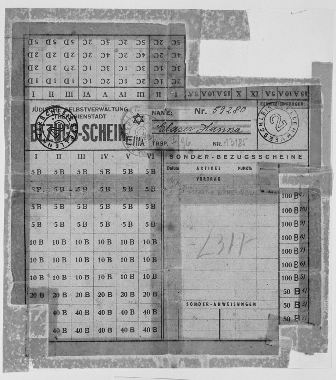
One shopped for one’s allocation, there was no other shopping, strange though that may appear to the present generation. Everything was rationed and there was no choice. It was war and, according to the German definition of it, it was “total war”. Everything was subsumed in the war effort, food was an important part of it and nobody was spared the burden which the war effort imposed. Hence the old received less and starved to death since they were “useless mouths”, they didn’t contribute to the war effort.
Civilians, a pre-war concept, had ceased to exist, all had to do their bit, the soldier at the front, the former civilian at the “home” front. The Second World War differed from previous wars which had been conducted solely by soldiers. Therefore the “bombing of civilians” is a misnomer.
The Effect of Rationing on Jews
Rationing was, as mentioned, part of the war effort and the race concept, which permeated everything, played its part. Thus rations in the Protektorat, particularly for Jews, were too small to survive on, the restricted shopping hour in the afternoon made sure, and was meant to make sure, that the few items which were seasonally available, like some vegetables, but not potatoes, had already been sold. Fruit too was, of course, seasonal but then Jews were not entitled to fruit anyway.
Our grocer, Mr. Svoboda, at the corner with the main street, would keep such things for us under the counter but at a price and we were short of that too and run out of things to sell.
The black market was dangerous for both the seller and the buyer. It meant concentration camp when caught and yet it went on because one was driven to use it if you could afford it, otherwise you went very hungry and your health deteriorated, not a good start for the even worse conditions of ghetto and slave labour camp.
Certainly our family, and I dare say everybody else, suffered from boils, mainly in the neck where shirt collars rubbed, because one had such a low resistance to infections due to lack of vitamins. As mentioned, apples, or any fruit and most vegetables, were forbidden to be sold to Jews. The daily procedure was to apply a very hot cotton or linen bag filled with linseed to the “unripe” boil to soften it before lancing it. This left a hole which took some time to heal. .
Once I had a boil in an armpit, a sweat gland became infected. The treatment for that was a dose of X-rays at the Jewish community’s surgery in town. That dealt with it more or less instantly but then one didn’t want too many of these either.
The Social Barriers Enforced
On the class photo, extreme left, third line from front, is Edith. She wears a light-coloured blouse with a white collar and she smiles. She was an extremely pretty girl with Jewish-oriental features, very tall, very slim, a narrow face. Actually she had nothing to smile about but one can’t allow grim reality to rule all the time. Her father was a doctor and one day he disappeared. It is likely that one of his non-Jewish patients of pre-occupation days came to consult him.
As this was a social and professional intercourse between Jews and non-Jew and also of a type specifically prohibited even if the other party was Czech and therefore Slav and therefore very low in the eyes of the Herrenvolk, such meeting could mean deportation and death, although one always lived in hope because the existence of the many extermination camps was then unknown.
Most likely her father was not on the small list of Jewish doctors permitted to practice medicine and that was restricted to fellow Jews. That meant that he had no income and so was forced to break the rules.
We had a similar experience with the practice of medicine though the facts were slightly different and the consequences less tragic. My mother suffered from migraine and high blood pressure. My father arranged for a doctor to call. This doctor was, presumably, one of the few on the permitted list. He himself was Jewish and therefore could only treat Jewish patients. So far so good.
In fact he came quite often and I too went quite frequently to his flat which was near the centre of Prague. I can’t remember why I used to go there, perhaps to make another appointment, collect medicine, pay his fee, communications without the use of a phone or post office and us living in the outskirts of town was difficult and I was young and could walk.
The problem was that he was married to an Aryan, a mixed marriage, which protected him from transportation. Even that would have been alright, as was the fact that his wife was German. In those respects a couple on the floor below us in our block of flats in Líbeň were identical.
Unfortunately his wife had acting ambitions and in spite of her close Jewish connections she had bit parts by UfA, the German State film producers and she was thus also socially tied to other Germans. How her Jewish husband fitted into all this I don’t know. Any social intercourse between Germans and Jews, and her acquaintances were bound to have been Nazis, was forbidden and certainly not sought by her German fellow actors and producers.
Possibly her social life took place outside their flat where her friends would have come face to face with this sub-human. However in the eyes of the Gestapo there was this real, if infinitesimally small possibility that we, through the dealings with the husband doctor, had come into contact with Germans who had therefore been defiled. My father was called to the Petschek Palace. Peček had been a banker. His imposing palatial bank building had immediately been taken over by the Gestapo as their headquarter on the day they arrived, on 15 March 1939.
What Mr. Neville Chamberlain had swallowed so gullibly, namely Hitler’s pronouncement after the Sudeten had been handed to him on a platter by Britain and France, although it hadn’t been theirs to give away to a bloodthirsty dictator, “I have no more territorial claims”, was found to have been false. Germany’s territorial ambitions were insatiable, this was only the beginning and soon everything fell into place.
The Gestapo had had its eyes on the Petschek Palace long before 15 March 1939, there had been plenty of Nazis among the Prague Germans who had cased the joint for them. The plans to convert it into torture chambers, prison compartments and offices had been prepared well in advance and were implemented immediately. No grass grew under their feet.
What must also be understood, to avoid any misunderstanding, is the role of the German army, the Wehrmacht. It was they who occupied the country and it was they who made it possible for the Gestapo, and all the other segments of the Nazi terror machine, to follow in their footsteps and set up their nefarious business, whether in France, Holland, Belgium, Norway, Denmark, Poland or Czechoslovakia. There was nothing honourable about them, they played their part in the conspiracy to rule all of Europe and the devil take its non-German inhabitants. They were, literally, the driving force.
To be called, or to be dragged, to the Petschek Palace filled one with dread. Not many emerged alive. I wasn’t even told that my father had been “asked” to attend. I don’t know what happened, my parents wanted to spare me this unpleasantness.
I do remember that the message on my antennae was that father, as a preliminary to interrogation, had to do a hundred push-ups. He was then 45. It would have been strenuous for a man half his age and nobody was physically fit. After that he must have convinced the interrogator that there had been no encounter between any of us and the doctor’s wife’s German associates because he returned to home or office afterwards.
As for the doctor, I now don’t think much of his doctoring. I know that my father suffered from low blood pressure and had pills to counteract that. My mother had no pills for her high blood pressure. May be there weren’t any in those days, in 1941.
What he did every time he called, was to stick a needle into my mother’s arm and drain about a pint of blood, the idea being that less blood will cause a drop in pressure. I gave blood from May 1950 in London until I was 70 in Suffolk. Thus I know that the blood-creating system of the human body replenishes donated blood within a very short period and that therefore my mother’s blood pressure too would have returned to its original high value shortly after each treatment.
Vermőgenserklärungen -Property Declarations
I will add here that selling one’s own property was a serious offence and very risky. The Germans wanted all of it and had made the head of every Jewish household sign that he wouldn’t part with any of it. That would include selling or hiding it. Every member of the household also had to fill in a very lengthy (16 pages in Germany, more if in two languages) and very detailed form listing every possible item of property, from lampshades to carpets, shirts to shoes to coats, cooking pots, frying pans, knives, forks and spoons of every size and description, pictures, tables, chairs, beds, etc.
There were fears that if, on the household being emptied and put in a removal van, the contents would be checked against the items declared on the form and any discrepancy would have dire consequences.
That never happened, cross-checking would have been very time-consuming and anyway, the members of the household could very well be dead by then. Others put everything on the list, hid nothing, sold nothing and hoped that the list would become the basis of restitution. That too didn’t happen. The majority of families were completely wiped out, the lists disappeared, certainly in what is now the Czech Republic, very few survivors became eligible for restitution, those who happened to live in any of the Eastern Block countries were excluded from such payments and the amount of restitution was fixed by the Germans themselves and bore no relation to the value of the looted goods.
My father displayed more sense, took any real or imaginary risk, didn’t declare and sold some of the few valuable items we had brought with us from Berlin, an old German gold coin, a Persian carpet, things like that.
Operation Barbarossa
The Wehrmacht struck at Russia on 22 June 1941 and carried the attack without interruption to the gates of Moscow. 1942 saw it at the Volga and the Caucasus. Von Paulus didn’t surrender at Stalingrad until 2 February 1943. Its success lasted for a full 19 months which heartened even the few German waverers Hitler was right, they were a super race, a Herrenvolk, plucked by destiny to rule over others and that the end justified the means.
However, from Stalingrad onwards it was a constant retreat, slow at first but accelerating. Whether moving rapidly forward over 19 months or back over 27 months, the long lines of communication for most of the time required all parts of a vast railway network to be maintained, coal and water, locomotives, goods wagons, open and closed, and carriages to be maintained, to be moved precisely, time tables to be worked out daily for the movement of troops, arms, ammunition, food, tanks, new ones and damaged ones for repair, the injured, the frost-bitten, to be moved forward and back, drivers, firemen and guards to be in the right place at the right time, a vast undertaking carried out by civilians.
And yet, stretched as they were: locomotives, drivers, firemen, SS-guards and time tablers were always found across a vast network, from Greece to Treblinka, from Vichy France and Holland, from Hungary and Slovakia to Auschwitz, to carry Jews to their death.
My Bar Mitzvah
The title of this paragraph is bar mitzvah, but may be it should be the plural bar mitzvot or rather, while I had only one barmizvah I prepared for three. I was born in October 1928, I was thirteen in October 1941. Thirteen is the age when this religious initiation ceremony takes place in normal times. These were not normal times. My class teacher was Dr.George Glanzberg. He is the teacher on the right of the class photo. He was born in 1912, i.e. in 1941 he was 29. His parents were very devout, very orthodox.
In spite of their straightened means their son took a doctorate in Oriental languages. He spoke Czech, German, Hebrew ancient and modern, probably Arabic and certainly Yiddish. He organised chess competitions at school. He was popular and easy going, not an easy task with a class of 50 pupils though we were not like other children, the times we lived in made us much more serious and responsible.
Those were not the times when one celebrated anything. It was difficult to meet, we could not use public transport, food was very scarce, we lived way out, none of our relatives in Prague, all from my father’s side, were around any more. My father, who was not at all religious, was probably indifferent, he had other things on his mind. Dr.Glanzberg asked him whether he could prepare me for my bar mitzvah. To him, in spite of the depression, fear, anxiety, worry, weariness, uncertainty and concern about the unknown destinations to ghetto and farther East and what it could mean, it was some-thing that ought to be done in spite of these facets of our lives.
Or may be because of them, an old certainty in an uncertain world -it was to be the bare essentials - a reading of the haftarah, ie. A portion of the Old Testament, usually from the Prophets. None of the celebrations and expensive ostentation of nowadays.
On my 13th birthday my parents gave me a pocket watch and a microscope with up to 300x magnification, but that was strictly for my birthday. Both of these items were hidden, both were returned and both were stolen in Teplitz four years later when I started an apprenticeship there. The watch was stolen from the locker of the factory where I kept my winter coat and dustcoat, the microscope from its box kept in the desk of the director of the hostel where I then lived, probably by former members of the Hitlerjugend.
The first haftarah (Isaiah 40:1) I learned was very moving because it was so apposite to our condition: “Nachamu, nachamu ami, j’omar elohechem…” or, as the German translation on the opposite page had it: “Tröstet, tröstet mein Volk, spricht euer Gott…” “Comfort ye, comfort ye my people, says your God, speak comfortably to Jerusalem, and cry to her, that her war service is ended, that her iniquity is pardoned: for she has received of the Lord’s hand double for all her sins.”
It then carries on: “ Kol koreh bamidbar…” “a voice cries in the wilderness: Prepare ye the way of the Lord, make straight in the desert a highway for our God. Every valley shall be exalted, and every mountain and hill shall be made low: and the crooked shall be made straight, and the rough places plain”, which Händel used in the Messiah and which reminds me of the portion I was to read every time I hear it.
Preparing for it did not represent a problem. I had learned to read Hebrew in my Berlin primary school, I just needed to speed it up. It never happened. Shortly before it was due the organisers feared a razzia on the synagogue, a raid by the Gestapo or SS during a service, taking the worshippers away never to be seen again, their favourite past-time. So I prepared for another one. This time it was Isaiah 54: “Rani akarah lo jaladah…” (Sing o barren one, though you did not bear, break forth into singing and cry aloud though you did not travail with child: for more are the children of the desolate than the children of the married wife, says the Lord).
The same thing happened. The organisers got cold feet and the bar mitzvah was abandoned. There was a third attempt. This time it was not to take place in a synagogue but in a shtiebl, a prayer room (German, Schtübe = room) where a quorum, or minyan, including Dr.Glanzberg, had assembled. What I recited on that occasion I cannot now remember. It was a very subdued affair. The schtiebl was in the Old Town.
My parents were absent, as already mentioned, we were forbidden to use public transport and lived on the outskirts of town, it would have meant a long walk in winter on icy roads and my father undertook that walk every day already.
There were some technical hitches, my father didn’t know what his Hebrew name was, one had to be invented so that I could be called by my Hebrew name as “son of” (ben). My Hebrew name by which I was known when a member of the Zionist scout organisation Techelet Lavan (blue-white) was “Chanan” and so I was known in the ghetto. When Paul Kling called me from California he still called me that.
Dr.Glanzberg gave me a small prayer book inscribed with my name. Like nearly everything else it was lost. Visits to Dr.Glanzberg’s parents’ home did not consist entirely in coming to grips with my portion of the Torah, the Old Testament. Sometimes we played chess. Dr.Glanzberg was a very good player, his favourite grandmaster was Niemzovitch and his favourite positional play was “stonewalling”, where pawns stand in diagonal lines supporting one another.
The family was sent to Theresienstadt on 8 July 1943 (transport Dh), i.e. five days before us. Dr.George and his brother Saul were sent to Auschwitz on 18 May 1944 (transport Eb) the last of three transports sent within three days between 15 May 1944 and 18 May 1944, transport Dz of 2,503 people of whom 120 survived, transport Ea of 2,500 people of whom just 8 survived and transport Eb of 2,500 people of whom 273 survived. Dr Glanzberg was not among them.
There is no rhyme or reason for these discrepancies in murder rates of between 99.7%, 89.1% and 95.2%.
What Did I do With My Spare Time
School was either in the morning or during the afternoon. On the one hand it was somewhere to go, and there weren’t many places one could go to as public places and spaces were closed to us, on the other hand it was somewhat boring and I didn’t feel “stretched”.
I knew German, one of the compulsory subjects, and Czech grammar because I had received tuition shortly after we had moved into our flat. My arithmetic was good because a teacher from the Sudeten who lived on the floor below us had volunteered to teach me, the geography of the Czech lands, where we concentrated on its rivers, just didn’t interest me.
Subjects I would have taken to with enthusiasm we weren’t taught, probably because the Germans dictated the syllabus and there were no facilities to teach science. I had time on my hands. What did I do, how did I amuse myself. There were really very few opportunities other than to sit at home and read.
To visit school friends was out. They lived in or on the other side of Prague, I had already walked several miles to and from school, public transport was “verboten”, to retrace my steps back into the Old Town or beyond it just didn’t appeal, one experience of not getting back before the start of the curfew had been enough and Prague is either very cold in winter or very hot and humid in summer.
Our radio had been taken from us, so no radio to listen to. German propaganda wouldn’t have appealed anyway. We were not allowed ho have newspapers, so that was out. Strangely enough there was a playing field but that was opposite the cemetery where I was to work after the school had been closed and that too was a fair distance away, one tended to conserve energy.
During the first two winters, ‘39/’40 and ‘40/’41, I went there to skate on the tennis courts onto which water had been sprayed which had frozen, winters are cold enough for that to happen between October and March. I had learned to skate in Berlin on similar surfaces. Libraries were closed to us, another one of the many decrees restricting life. Cinemas, youth clubs, public performances, sporting events were closed to us. So what did I do?
The Chemistry Set
I was keen on chemistry. So keen in fact that when Friedl Bloch from the ground floor was due to be deported to the ghetto he gave me his two chemistry books, one on organic and the other one on inorganic chemistry.
When it was our turn to leave Prague I packed the book on organic chemistry. Should have taken a pair of shoes or a sweater instead, we could only take one bag of a specified size. I did have a chemistry set. I could burn a short string of sulphur in a corked bottle filled with a little water. It would extinguish itself when the oxygen had been taken up.
Swirling the water in the bottle would cause it to absorb the sulphur dioxide gas turning it into a weak sulphurous acid which could be verifies with a strip of litmus paper. Burning sulphur with iron filings would create, somehow, I can’t remember what else one had to do, sulphuretted hydrogen, H2S, the smell of rotten eggs.
A few chips of wood could be heated in a test tube with a small glass tube tube pushed through the cork at the open end. The glass tube had been heated and pulled apart resulting in a reduced diameter and a very small opening. The distilled gas created by heating the chips without oxygen could be ignited. The process was similar to the manufacture of town gas from coal with coke as the residue or of wood when the residue was charcoal.
I made thermite bombs with strips of magnesium foil. The building was new, the builders had left a large open area in an untidy state. There happened to be plenty of heaps of sand to ignite my thermite flares. I used to throw crystals of cooking salt into the flame of the cooker to see the flames turn bright yellow, the spectrum of Sodium (Na, Natrium). But there is a limit to the number of times one can repeat the same experiment.
My Favourite Books
I tried to help my mother in the flat but it was a very small one. There wasn’t much food and therefore much cooking or baking and therefore little washing up to do. However little there was of it I would dry up and got paid pocket money for doing so.
With that pocket money I bought books. Two thick tomes I remember in particular. One was called “Du und die Natur” (You and Nature) and was popular physics. The other one was called “Du und die Erde (You and the Earth) and was popular economics. Both were excellent, both had been published by Ullstein which had been Jewish before it was Aryanised, the euphemism for forcible confiscation or expropriation.
The physics book explained how the speed of light. had been established, how the mass of a mountain would bend light, how the mass of stars bends light, multi-dimensional space, the relationship between time and speed, the absolute speed of light, the theory of relativity, the latter without once mentioning Einstein, Jews were unmentionable, just as the lowest cast in Hindu society is untouchable, outcasts.
The book about global economy, global markets, how seeds of the rubber plant were smuggled from Africa into Malaysia where the climate was identical and thus the previous monopoly was broken. The invention of the vulcanisation of rubber, by mixing and heating it with sulphur, enabled the pneumatic tyre industry, and with it the car industry, to take off.
I had other popular science and history books. That’s how I know that the version of Händel’s Messiah one hears to-day was written by Mozart who, as a six-year old listened just once to a sacred and secret choral work at the Vatican, went back to the hotel where he was staying with his father and wrote the jealously guarded work down note by note and that the Germans word for advertisement, “Reklame”, derives from the Latin “reclamare” or shout again, all bits of useless information collectively known as general knowledge. I had three volumes by Sven Hedin, a Swedish explorer turned Nazi, but I didn't ’now that at the time.
Arithmetic and Algebra
The teacher from the Sudeten who lived with his German wife on the floor below us had taught me algebra but once you know how to multiply and divide sums of ps and qs to the powers of n and m and expand a series (a+b)n there isn’t much one can do with it, not by oneself at home anyway.
It may have been a useful tool which I didn’t know how to use. I wasn’t aware, again because I had nobody to tell me, of its uses in probability. What I did do, for hours, was to take square roots. A strange pastime considering that nowadays one taps out a number on a cheap calculator and presses the square root button and the answer to at least ten decimal places appears before one has lifted the finger off the “equal” button. Not quite so simple then.
There were slide rules which gave a rough answer, logarithmic tables from four to six figures which one could interpolate to one more digit and use anti-logarithms to get an answer. Somebody had shown me how to take a square root to any number of decimal places, a matter of repeated division, and that is what I did.
Chess by Myself
My uncle Fritz had sent me a book on chess by the Jewish grandmaster Emanuel Lasker and I replayed the annotated games studying the explanations for each and every move. According to Lasker’s philosophy successful chess and successful life were both based on the sum of small advantages, not on sudden flashes of genius which sees the winning move and employs spectacular sacrifices but by building up a good position by early development of all of the pieces in their best position, controlling the centre with low cost pawns and employing the heavy artillery of the castles and the medium artillery of the bishops over the greatest possible distance. This “positional” play should enable one to seize opportunities to one’s advantage.
Money
My father approached Reinhold Matzat for a loan. One had to be an optimist. People guessed but didn’t want to know what was in store. He would pay it back after the war. Matzat was an intelligent man. In addition his son from his first marriage was now a young officer in the SS.
They may not have discussed Jews but he probably knew full well what was going on. In Berlin, or other places, you could hardly miss it if you kept your eyes only half open.
By 1940 my uncle Fritz had been reduced from being a director of the Dresdner Bank to being a forced labourer in a munitions factory and from living in a villa which he had built to sharing a furnished room with his wife, by then also a forced labourer in an A.E.G. electrical appliances factory.
And Herr Matzat had known Uncle Fritz too. In those circumstances a loan was actually a gift.
One evening the bell rang at our small flat in Prague. It was “X” in raincoat with the circular emblem of a member of the Nazi party on his lapel, the standard attire of a genuine party member. It was the perfect cover. Nobody ever questioned a party faithful and asked him what a Berlin member with load of cash in his pocket was doing in a working class district of Prague on a dark evening.
I was told to go into the bedroom, the flat only had one living and one bedroom. The less I knew the better. I do know however that he handed over a wad of notes and he also told my parents how surprised the average German had been at the invasion of Russia.
After all, the Russians had been delivering vast amounts of raw materials punctually and diligently, playing by the book to help the German war effort, at the time directed against Great Britain, Europe having been occupied and America wasn’t yet in the war. Then why disturb a relationship which worked decidedly in Germany’s favour? One can therefore time “X’s” visit to about a fortnight after 22 June 1941, the beginning of Operation Barbarossa.
I don’t know how much money was involved. I don’t know how long it lasted. We were sent to Theresienstadt on 13 July 1943 or two years later. It did not save my parents who were gassed at Auschwitz on arrival in Sept./Oct. 1944 when my father was 47 and my mother was 52. But it made our life while still in Prague more bearable.
Where it ranks in the hierarchy of friendly acts I don’t know. If I were cynical I would say that it was conscience money but there were a great many Germans who looked the other way when it came to Jews with whom they had been friends. Whatever, it came in useful.
The Black Market
It should be understood that our purchases of food on the black market were few and far between, it was expensive and very dangerous - the penalty was death. As far as fat was concerned that would be in a raw state and had to be rendered down. That smelled and was dangerous in itself, particularly in such a densely populated block, neighbours could become suspicious that you were up to something and inform on you.
Of meat all I remember is of a skinned kid appearing. There was no refrigeration, the kid would have passed through several hands between farm and an urban area, a very dangerous operation and the risk was reflected in the price. By the time it arrived it was not as fresh as one would have wished, in summer anyway.
The treatment was to soak such material in a solution made up of water in which mauve crystals had been dissolved. These crystals were, as far as I can remember, called hyper-permanganate, something like Mn204, which dyed everything it came into contact with brown. The idea was that it also gave off some of its oxygen (like in peroxide) and that the oxygen would have sterilised the offending bacteria.
Work on the Cemetery
After my school had been closed at the beginning of June 1942 my father and one of his colleagues, who had had a furniture removal business before it was Aryanised and who lived along the road to the school, arranged for his daughter and me to have private lessons with Dr.Rand, another class teacher, he stands on the left on the class photo.
It was the first and last time that I learned a little bit of Latin and liked it very much though I got never farther than the declension of “servus”. Not all that difficult, Latin may have six cases, Czech has seven. This first step towards secondary education came to an abrupt end as a result of yet another order prohibiting private education of Jewish children.
Everybody had to work and as my father didn’t want me to contribute to the German war effort he got me a job on the Jewish Olšanský cemetery at the junction of the long Vinohradská street and the end of the district of Žižkov and it was in the open air. It was about two thirds of the distance I had been walking to school except that now the first part of the journey was very long and steep, Žižkov being much higher than Líbeň. I started there in the early autumn, say in September 1942.
I had always thought that I had been an apprentice there. Now I know that apprenticeships were not open to Jews and on the list of employees of the Jewish Community in the year 1942, contained in the appendix of a book on Jews in the Protektorat, I am listed as merely gardening assistant.
At the time I was the only intake. The head gardener and his young wife were refugees from the Sudeten. There were existing workers, Jews and non-Jews, grave diggers, those who swept paths, received corpses, put them on slabs in to mortuary, put them into coffins, lowered the coffins, filled the graves with soil, levelled it roughly and carried away the surplus soil.
We then came along, put topsoil on, levelled and compacted it accurately, sowed grass seed, planted flowers. The workers played the tricks expected of them, e.g. asking me to give a hand by getting hold of a cloth-covered leg of a stiff corpse to see my reaction. I didn’t mind. I was to handle a good many more filling in mass graves of those who had died on death marches two years later.
My jobs varied and proved useful throughout my married life when we moved frequently and often I had to start a garden from scratch. The cemetery had a very long alleyway lined with trees and I learned to prune them. I made putty, then made by hand, a mix of whiting and raw linseed oil, kneaded and kneaded until it became soft and pliable.
It was then used to fit glass panes into cold frames. The head gardener, another refugee from the Sudeten, Werner Neufliess somehow obtained a load of cow manure which developed heat as it matured in these glazed cold frames. The winter was extremely cold in those parts but it was dry and the sun shone, it was therefore warm behind the glass and the soil and manure acted as an insulator at night. Marrow seedlings were grown from seed in these frames. In spring when the danger of frost had gone the glass covers were left off.
After the onset of frost all the leaves from the whole of the cemetery were collected and heaped onto one huge mound. The snow which covered it acted as insulation, the leaves combusted slowly inside and in early spring we had a large heap of grey ash which we used as compost for a large vegetable plot.
One of my jobs in the depth of winter was to prepare seed trays and to grow tomato and marrow seedlings from seed. The trays were put on shelves along the wall of the heated mess room where the workers took their meals. The seedlings were then transplanted into small pots and eventually they were planted out in rows and staked in the vegetable garden which had by then be established with the help of some of my class mates who had spent the winter doing other but indoor jobs.
My other winter job was to sit in a hut at the end of the cemetery. At the far end of the cemetery there was a narrow gate. My job was to see to it that nobody, except our labourers, crossed from the cemetery to the other side of the gate or vice versa. At the other side of the gate was a single storey building housing the ashes of those who had been cremated. According to orthodox law Jews must not be cremated but must be buried. This gate represented the clash between these two Jewish outlooks which had to be kept strictly apart.
Nobody visited either place and there were hardly any funerals. Not that Jews had stopped dying, far from it, but they didn’t die in Prague. Prague Jews were then dying in ghettos, from Riga to Lodž to Theresienstadt, and in extermination camps from Maly Trostinec to Minsk, Sobibor, Majdanek, Belzec and Treblinka, and those in Auschwitz were certainly cremated. I didn’t know that at the time and yet felt that the job guarding a gate through which nobody passed, and to stop if anybody did, as rather unproductive.
Sitting in that small hut I looked out onto a snow-covered plot from which the tips of leeks projected. My deported predecessors must have planted them and leeks have the great advantage that they can remain in the soil, they do not deteriorate and can be harvested by being pulled out at any time during the winter.
So every day I pulled out two leeks and took them home, a welcome addition to our meagre supply of vegetables. Every day my meal, which I had brought from home in a saucepan sealed with a rubber ring, consisted though of tomato soup. Tinned Italian tomato purée was one of the few items more or less always available.
A conversation I had one day close to that hut has remained with me ever since. I was then 14 and the boy who was doing some work nearby was probably 16 or 17. We had an argument and I called him an idiot. As the Jewish workers on the cemetery were well educated he told me, in a measured voice to show off his superiority that, contrary to my belief, the word “idiot” was Greek and did not mean a stupid person as
I had obviously assumed, and it was not an insult. It meant a “private” person, one who kept himself to himself and did not participate in the business of running the place, the polis. I fully under-stood that he meant the ancient Greeks in the days when real democracy was being invented by them, when the common people enacted legislation, decided who was to lead them in war and were judge and jury in trials held in public because they, the “demos”, the commons, had the “kratos”, the power. Of course, they did look down on idiots and it was derogatory.
Ever since I had this short but significant lesson in classical education and political science I have felt that only active participation and not just putting a cross against a name every four or five years is the duty of the citizen. In early spring of 1943 many of my class mates appeared on the cemetery and we converted a large open space into a vegetable plot, as already mentioned, by digging, weeding, raking, setting out paths and plots, spreading and hoeing in the leaf compost and seedlings or transplanting seedlings.
I learned how to tie up tomato plants and remove suckers as they appear between stem and fruit-bearing branch, how to weed with a hoe and how to water. Watering was done as it would have been done in Palestine, to conserve or be most efficient with water. Seedlings were planted below the surrounding ground level and a circular hollow formed around them at this lower level.
The watering can would be directed into this hollow and the water was thus concentrated on where it would do most good, the root of the plant. Nothing ran off, we didn’t even use trenches to water, that would have been wasteful in a country short of water. Not that Prague was short of water, we were only daydreaming that we were preparing for aliyah, for “going up” to Israel to till the land there and we were learning to do that. Of the dozen or so youngsters on that large plot I am the only one who survived and I came to England.
As far as I remember we grew marrows in cold frames and in the open we planted tomatoes, onions, spring onions, carrots, leeks, beans and cabbages. Prague has a completely different climate from England, it is consistently sunny and warmer and reliably so and thus by the beginning of July, the month by the middle of which we had all been deported, everything had been harvested and sent in food parcels to the ghetto.
At one end of the garden was a roofed area which gave welcome shade and had a table-tennis table and that is where were spent our lunch break. Some of us, not me, were very good at table tennis and would spin and smash the ball and start the spin below the table.
My reaction time was far too slow to manage such a fast game. Sometimes we would eat together and one of us would read aloud a passage from a book. Most of were Czech-Jewish children born in Prague. It is just as well that our last three or four months on the cemetery garden were happy ones, one felt one was doing something positive, useful, was close to nature at her best and enclosed as we were by a high wall on one side and acres of trees and plain stone and ornate Victorian-type mausoleum on the other we were screened from reality.
One of that group was Bedřich, or Frederick, Fantl whom a particularly terrible fate awaited. He was to end up in the “Family Camp” in Auschwitz where they knew well in advance when they were going to be gassed.
As he lived with his parents and younger sister in the flat above us we walked together to work and on the long, straight and steep way up to Žižkov we would play blind chess, trying to remember the moves we had made, just like the grandmasters did. A good mental exercise though I don’t remember ever finishing a game. I was very keen on chess but being keen doesn’t mean one is good at it.
Encephalitis
One day, it was warm, I was hoeing barefoot and I hoed into my right toe, nothing serious, just removed a little bit of skin. Soon I felt very queezy and decided to go home, it was becoming that bad. It was a long walk at the best of times and if I didn’t get going soon I knew I wouldn’t make it.
I did walk home. A tram would have taken me part of the way but we weren’t allowed on trams. I made it, went straight to bed, asked for the blind to be drawn because light gave me a terrible headache. When my father came home he phoned a doctor and that was when the public phone in the entrance lobby proved to be invaluable, Jews had had to give up their private phones a long time before that. He could only summon an approved Jewish doctor who, in turn, could only treat Jewish patients.
Only these very few approved doctors had telephones. I assume that my father knew whom he was going to call but whoever it was had a long journey on foot ahead of him and had to carry his case. All I remember is that a middle-aged Dr.Teitelbohm, I am not sure of the spelling, appeared some time later. He was a brilliant man and from my father’s description of my symptoms he had on him an ampulla of Cibazol.
Having been keen on the composition of drugs ever since I had read “The Microbe Hunters"”four years earlier I still remember that one. Ciba was the name of the Swiss pharmaceutical manufacturer and “thiazol” was the ending of the formula di-oxy-diamino-sulphonamido-thiazol.
Using the method of intravenous injection he could get the drug to work in the right area immediately. He had tested the pupils of my eyes with a torch, they did not contract, the splitting headache and my temperature confirmed his diagnosis of encephalitis.
After the injection I got better quite quickly. To him I owe my life. Cibazol, one of the early sulphonamides, was then new on the market and if he had not had it on him several vital hours would have elapsed before it could have been obtained, even a day, because the time when chemists’ shops were open to Jews was the same as the shopping hours, from 3:00pm to 5:00pm. Dr.Teitelbohm died of typhus, caring for his patients. His wife, also a doctor, survived.
Loading Belongings
Some two weeks before it was our turn transports left in rapid succession. Prague was to be cleansed of Jews who had by now completed the task allotted to them by the Germans, namely the listing, collection, sorting, valuing and disposing of the properties the already deported Jews had left behind. I was volunteered to help with the collection of luggage. Every deportee could take a large bag of a prescribed dimension, something like a British army duffel bag but slightly larger.
One was recommended to take sleeping bags, blankets and winter clothing which took much of the space. The uniform size and shape of the bags made them easier to load. I should here mention the obvious: These last remnants of one’s possessions were also looted. Their original and rightful owners would pack them once again when sent from the ghetto to, say, Auschwitz where on arrival they would be seized.
Prisoners would then open and sort the contents. In Auschwitz that department was called “Kanada”, presumably these bags contained riches and Canada was thought of as being a rich country. The removal vans used by our team were drawn by two heavy horses and the operation was carried out at night for which we were issued with special passes. In those days there were only two means of transporting over distances, trains and horses.
Inside cities there were buses, e.g. Berlin, or electric trams, e.g. Prague. Even pre-war Berlin had been full of horses for deliveries, removal vans and hearses. Prague had a few lorries converted to run on wood chips. I can't remember whether steam was raised with them and they were thus steam engine driven or whether the chips were heated in an airtight cylinder and the gas given off provided the substitute for fuel.
The removal vans used by our team were drawn by two heavy horses and the operation was carried out at night for which we were issued with special passes. In those days there were only two means of transporting over distances, trains and horses. Inside cities there were buses, e.g. Berlin, or electric trams, e.g. Prague. Even pre-war Berlin had been full of horses for deliveries, removal vans and hearses. Prague had a few lorries converted to run on wood chips. I can't remember whether steam was raised with them and they were thus steam engine driven or whether the chips were heated in an airtight cylinder and the gas given off provided the substitute for fuel.
Deportation at night
The deportation of Jews from towns, certainly in German-occupied countries, was carried out at night so that a potentially sympathetic population was not aware of it. Fritz Behrendt and his brother Hans had also attended the Jewish Joseph Lehmann Schule in Berlin. Their father had supported an anti-Nazi party and he was on the Gestapo’s “wanted” list. He managed to travel to England, ostensibly on business, but couldn’t get a visa to stay and neither could he return to Berlin.
The family decided to flee to Holland which had remained neutral in the First World War and, so one hoped, Germany would respect again respect Holland’s neutrality should hostilities begin. The family met in Amsterdam and the Germans invaded on 10 May 1940. The brothers had just one Jewish grandmother. They were thus not Jewish enough to be deported and not German enough to serve at the front although they were called up. Fritz became an air-raid warden and he describes the events of 20 June 1943 in his book of political cartoons “Teilweise heiter” (partly cheerful).
On that occasion the air-raid sirens sounded in Amsterdam but no planes flew overhead. The ruse was used to keep people indoors. In Prague the Germans didn’t bother with such deception. Before he left for the ghetto Friedl Bloch had given me two of his chemistry books, one on organic and one on inorganic chemistry. Before that my most used toy had been a chemistry set. I wanted to know more so, instead of a pair of boots or socks I packed the volume on organic chemistry.
Our turn came on 12 July 1943 when a young man with a two-wheel pushcart arrived to take our three pieces of luggage. We were an isolated outpost, it would have been too costly to send a van and horses.
We walked behind him to the assembly point. It was in the open but that didn’t matter, July is a very warm month in those parts. It was there that the rumour of the invasion of Sicily reached us. Considering that it had happened only two days earlier that was pretty good going. Naturally it cheered us up, the war would be over soon, we could last it out. It wasn’t and most of us didn’t.
The next morning, 13 July 1943, the date mentioned in the archives and card indices as the date of our deportation, we were put on a train and soon arrived in the ghetto. Theresienstadt is not far from Prague.
While many photos of deportations show enclosed cattle wagons, or as writing on the outside dating from the First World War had specified, so many horses or so many men, ours was a third class passenger train continental style with varnished slatted wooden seats and backs, with a narrow central corridor. It was also such a train which took my mother and me to Auschwitz 15 months later when I had just turned 16.
Sources: The unpublished memoirs of Frank Bright – Selected extracts used with full permission. Dedicated to Hermann and Toni Brichta – Both murdered in Auschwitz "Produced by Chris Webb" Online version: Copyright H.E.A.R.T 2008
Copyright. Frank Brichta H.E.A.R.T 2008
|